 ConsentX
DPDPA is being phased in. Scan your site to see where you stand. Scan now
ConsentXBlock Non-Essential Trackers Before Consent
Block non-essential cookies, trackers, and scripts before consent to support privacy and cookie compliance.
No credit card required · Quick deployment
Recording a choice is easy; preventing a tracker from running before that choice is the part most platforms skip. Prior-script blocking is the control that turns a banner into actual compliance. Allowing trackers to run before consent can create significant cookie compliance and regulatory risk.
ConsentX runs prior-script blocking as part of a full consent management platform, so your cookie consent banner, your Google Consent Mode v2 signals and your blocking rules all follow the same visitor decision. Run the free cookie scanner to see which tags fire before consent on your site today, and read what GDPR compliance expects of prior consent.
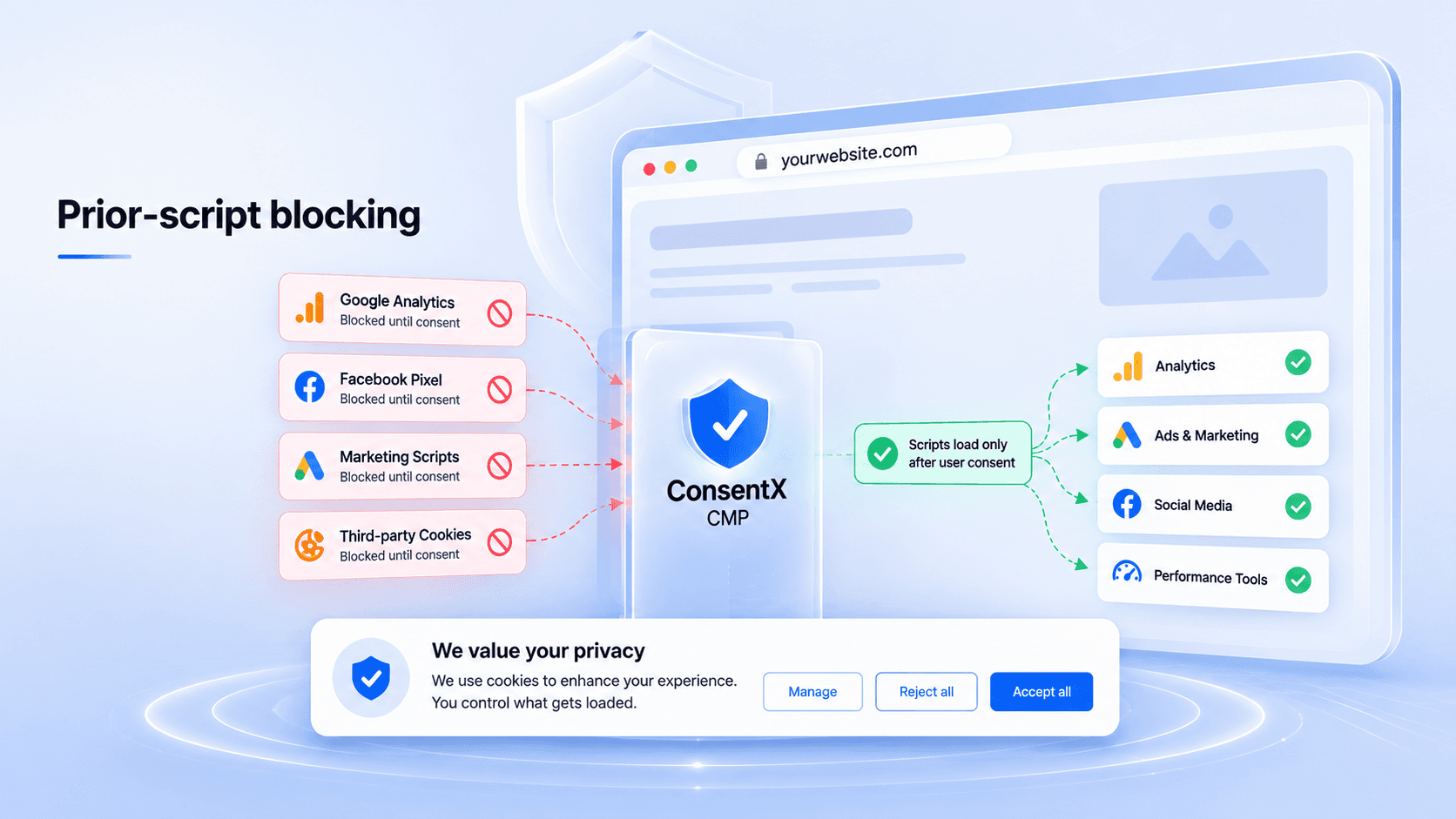
Prior-script blocking prevents non-essential third-party scripts, trackers, tags, and cookies from running before a visitor gives the required cookie consent.
Prior consent means non-essential trackers must stay inert until the user agrees, and prior blocking is the technical enforcement that keeps them from firing on the first page view.
Showing a banner is not enough if tags already fired. Regulators expect trackers to be genuinely blocked before consent. Many tools leak tags on load. ConsentX enforces real prior-script blocking, so nothing non-essential runs until the visitor opts in, which our xScan-AI scanner verifies.
The page loads with non-essential tags held back.
Your consent banner asks for a choice in plain language.
Analytics, advertising and marketing tags stay inert while the visitor decides.
Allow all, reject non-essential, or decide category by category.
Only the categories the visitor allowed are released.
A cookie consent banner is not enough if non-essential trackers run before a visitor makes a choice. Prior-script blocking prevents analytics, advertising pixels, and other third-party scripts from firing until the required consent is provided.
Nothing non-essential runs until the visitor says yes. If they say no, ConsentX sweeps the cookies that tried to set. That is the difference between looking compliant and being compliant.
ConsentX can block non-essential analytics scripts, advertising pixels, marketing tags, chat widgets, and other third-party trackers until the visitor provides the required consent.
Prior-script blocking works alongside a cookie consent management platform to enforce consent preferences across your website.
Measurement tags stay inert until analytics consent is given.
Ad pixels do not fire before the visitor allows advertising.
Marketing tags wait for the matching consent category.
Social pixels and social buttons are treated as non-essential third-party tags.
Session-replay and heatmap tools stay blocked until the visitor opts in.
Personalization tools wait for consent like any other non-essential technology.
Chat widgets and embedded third-party content are held behind the consent gate.
Conversion tags release only after the matching category is allowed.
Start from what actually fires. The free cookie scanner and xScan-AI list the cookies and third-party tags loading on your site before any consent choice is made.
Sort each tag into essential and non-essential, then into the consent categories you present: analytics, advertising, marketing and the rest.
Tag scripts with data-cx-consent for precise per-category control, or let the engine auto-block untagged third-party tags it does not recognize. An allowlist protects essential infrastructure you must never block.
Nothing non-essential executes on first load. Blocked tags stay inert while the banner is still asking.
Blocked tags are released only when the matching category is allowed. If a category is rejected, ConsentX aggressively clears the cookies and storage it tried to set.
The decision behind every release is captured by ConsentX consent records and receipts, so you can show which categories were allowed or rejected, and when.
ConsentX gates scripts two ways: tag a script with data-cx-consent for precise per-category control, or let the engine auto-block untagged third-party tags it does not recognize. Either way nothing non-essential executes on first load.
This closes the gap a regulator cookie scan exposes, where analytics and ad pixels fire on page load while the banner is still asking. With ConsentX a fresh scan of your site shows zero non-essential tags before consent.
When a visitor rejects a category, ConsentX aggressively sweeps the cookies and storage that category tried to set, so a no is enforced rather than merely noted. A maintained tracker registry keeps the blocking and sweeping current as vendors change.
The widget is built to fail open: if ConsentX is ever unreachable, your site keeps working, while the blocking logic still defaults to safe behavior for untagged trackers.
Zero non-essential scripts on first load. Non-essential tags do not execute until the visitor provides the required consent.
Tag scripts with data-cx-consent for precise per-category control over which technologies may run.
Untagged third-party scripts the engine does not recognize are blocked automatically, and rejected categories are swept.
Blocking follows the same visitor decision as your region rules, so each jurisdiction gets the behavior you configured for it.
See the Region Rule EngineWhat ConsentX controls on your site depends on how your tags are implemented and configured. Tags gated with data-cx-consent are controlled per category, and untagged third-party scripts can be blocked automatically until consent.
Prevent non-essential trackers from firing before the visitor provides the required consent.
Control third-party scripts based on the visitor's selected consent categories, and automatically prevent untagged third-party trackers from running before consent.
Reduce the risk associated with trackers running before valid consent is obtained.
Help prevent rejected non-essential cookies and trackers from continuing to run after consent is denied.
Blocking rules, consent categories and allowlists are managed from the same dashboard as your banner.
Blocking follows the region rules you configure, so visitors in different jurisdictions get the behavior you set for their region.
Built to pass regulator and vendor cookie scans for prior consent.
Consistent enforcement across every site in the organization.
Prior-script blocking supports GDPR cookie compliance by preventing non-essential scripts, trackers, and cookies from running before the required consent is obtained.
Requirements differ from one regulation to the next. ConsentX gives you the controls to configure blocking for the regions you operate in, alongside the region rules that decide which banner and legal basis each visitor sees.
ConsentX keeps ecommerce stores compliant without tanking measurement: Consent Mode v2 keeps ads and analytics modeling, prior-script blocking stops leaks, and the banner converts without dark patterns.
ExploreConsentX gives SaaS companies the consent evidence enterprise buyers ask for in vendor-risk reviews: tamper-evident receipts, DSAR workflows and multi-region coverage, all from one platform.
ExploreConsentX serves publishers and media sites with Google Consent Mode v2, Consent Mode and TCF scaffolding, and prior-script blocking, so your ad stack stays compliant without losing yield to leaks.
ExploreBuilt for agencies managing many client sites: multi-tenant organizations, role-based access, per-client isolation and rule rollouts, so real blocking is standardized across every client site.
ExploreConsistent enforcement across every site in the organization, an allowlist for essential infrastructure you must never block, and a connection-checker that flags installs where tags load before ConsentX.
ExplorexScan-AI is an instant automated website privacy scanner built on Cloudflare URL Scanner v2. Enter a domain and it surfaces the cookies and third-party trackers that fire before consent, your likely region exposure and a plain-English risk score, so you know what to fix before you even sign up.
Point xScan-AI at any domain and get a plain-English risk report in seconds: the trackers running before consent, your region exposure, and what to fix first.
Checking against GDPR specifically? Try the GDPR scanner.
See what fires before consent.
Split essential from non-essential.
Tag scripts, or auto-block untagged.
Nothing non-essential runs on load.
Release on allow, sweep on reject.
Keep the record behind each choice.
Your banner, your Google Consent Mode v2 signals and your blocking rules all follow the same visitor decision, inside one consent management platform.
Blocking is the default: non-essential tags stay inert until the visitor opts in, and a rejected category is swept rather than merely noted.
Region rules decide what each visitor sees, and blocking follows the same decision across the jurisdictions you operate in.
Manage blocking rules and categories for every website in the organization from one dashboard.
Passes regulator and vendor cookie scans for prior consent, and a connection-checker flags installs where tags load before ConsentX.
One script tag alongside GTM, gtag, direct tags and common pixels, with a widget built to fail open.
Don't let your cookie banner become a passive notification.
Nothing non-essential runs until the visitor says yes. If they say no, ConsentX sweeps the cookies that tried to set. That is the difference between looking compliant and being compliant.