
Introduction
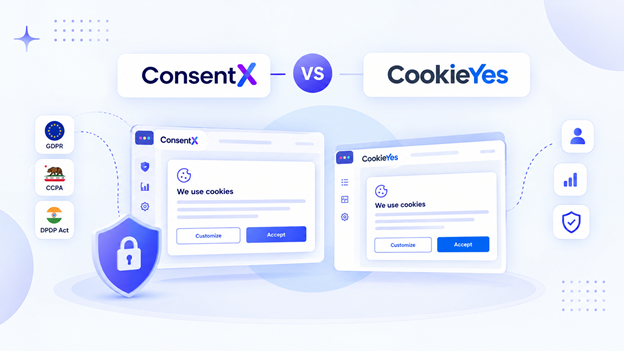
Every time users land on a site, data gets stored in their browsers called cookies. This data includes login details, language, user preferences, and shopping cart details. Some cookies also keep track of the actions of the users and their behavior online. Privacy laws now require that websites ask the users for their consent before storing this data.
Various Data Protection Laws such as the GDPR in Europe, the CCPA in California, and the DPDP Act in India give legal rights to users of their information. Websites that fail to comply could face stiff penalties, legal issues, and a loss of reputation. Even new companies and sites that do not have a significant following have to deal with privacy regulations if they have users who are based in regions covered by these laws.
A Consent Management Platform (CMP) is a tool that can help organizations achieve compliance with privacy laws. It gives an interface to users in the form of a cookie banner, asks the users for consent, disables certain trackers on the website, and stores the necessary information to prove compliance. In most cases, a CMP will offer options to users and allow them to revoke or grant consent at any time.
Organizations have several CMPs to choose from, and the two most common are CookieYes and ConsentX. Both CMPs help websites collect user consent and stay compliant with data privacy laws. However, they differ in several areas, including ease of use, customization, integration, features, and support. Whereas CookieYes is easier to set up and has a free plan, ConsentX has better tracking options, a larger geographical reach, and covers the DPDP Act in India.
ConsentX vs CookieYes: Key Differences
Before going deeply into the topic, let's take a closer look at the list below and understand the primary differences between the two.
| Area | ConsentX | CookieYes |
|---|---|---|
| Main focus | Consent management and strong consent proof | Cookie banner and quick cookie compliance |
| Consent logging | A core part of the product | Available, limits depend on the plan |
| Cookie scanning | Yes | Yes |
| Google Consent Mode v2 | Supported | Supported |
| India's DPDP Act | Strong focus | Limited or general focus |
| GDPR and CCPA | Supported | Supported |
| Free plan | Check the website for current offers | Yes, with limits |
| Best for | Teams that need audit-ready records and multi-law coverage | Small sites that want a fast and simple setup |
Both ConsentX and CookieYes offer cookie consent solutions; however, CookieYes is more focused on helping you launch faster with less hassle, and ConsentX is better at proving consent and ensuring that you are compliant with a wide range of regulations, which is an important consideration if you are running a business in India.
What Is ConsentX?
ConsentX is a consent management platform designed to help companies reduce privacy compliance risks. The tool lets you display a cookie banner, scan the website for cookies, and store records of each user’s cookie consent choices.
The service is notable for its emphasis on the audit trail necessary to demonstrate consent. Many privacy regulations around the world require companies to be able to provide a reliable audit trail of user consents for regulators and customers. In other words, if a customer asks you to provide the information about when a user gave their consent, you should be able to retrieve the required records quickly and transparently. This feature is particularly useful for businesses that work with the DPDP Act, which is India’s data privacy law. However, since it also complies with GDPR, CCPA, and other international regulations, it can be used for users from different parts of the world.
Finally, the tool is easy to use and does not require technical expertise. The dashboard is intuitive and designed in a way that allows non-developers to update the cookie banner, review cookies, and view consent records.
What Is CookieYes?
CookieYes is an advanced cookie consent solution that prioritizes extreme ease of use for non-coder professionals. With this tool, you are able to customize a cookie consent banner, scan your website for cookies, and block scripts from running until user permission is granted with minimal effort.
The service offers a free plan and three paid plans (Basic, Pro, and Ultimate), organized around the number of domains per month and the number of pageviews per domain. All plans include support for GDPR, CCPA/CPRA, LGPD, POPIA, and VCDPA regulations. Furthermore, Google Consent Mode v2 is available across all plans, while IAB TCF v2.3 is a higher-tier feature. According to public reviews, CookieYes also has a Google Gold Tier CMP certification.
The tool is most cost-effective for single-site users and small portfolios due to its “per domain” billing policy. Having discussed the main features of both cookie consent solutions, it is time to compare them against each other in the following table.
ConsentX vs CookieYes Feature Comparison
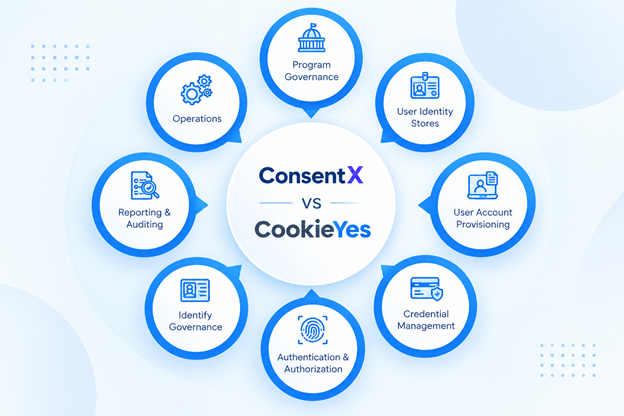
Features are the primary basis that highlight the key differences between the ConsentX vs CookieYes comparison. Both CMPs address the standard requirements, but the CookieYes suite offers advanced options in terms of evidence and regional compliance.
| Feature | ConsentX | CookieYes |
|---|---|---|
| Cookie consent banner | Yes, with 7 banner layouts | Yes, with pre-built layouts |
| Cookie scanner | Free scanner with no sign-up, plus xScan-AI | Built-in scanner, with page limits by plan |
| Blocking before consent | Prior-script blocking | Cookie auto-blocking |
| Google Consent Mode v2 | Yes, even on the free plan | Yes, on all plans |
| Region-based rules | Region Rule Engine, basic on free plan | Geo-targeting on Pro and above |
| Consent records | Tamper-evident receipts and audit exports | Consent logs |
| DSAR and grievance tools | Yes, with SLA timers on Pro | Not its main focus |
| Multi-site management | Up to 10 sites on Pro, 50 on Business | Priced and managed per domain |
Based on the information provided, it is possible to conclude that CookieYes is more comprehensive in terms of features. Although at first glance, the available solutions may seem similar, ConsentX has additional tools to help the user verify the absence of tracking cookies and ensure DSAR compliance in case of an audit. The rule engine and built-in DSAR workflow appear to be beneficial for organizations with multiple domains. In contrast, the basic set of features offered by CookieYes should be sufficient for a solo performer who only needs to display a cookie consent banner.
Know More: Google Consent Mode vs CMP: What's the Difference?
Privacy Compliance Coverage
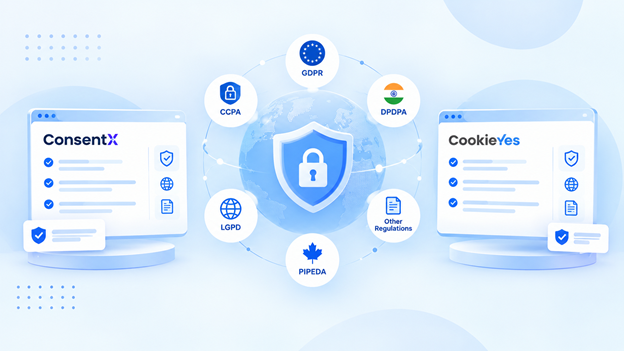
Privacy law compliance drives CMP usage. Hence, CMPs’ coverage of relevant regulations is of utmost importance.
Below are the essential differences in the legislation supported by ConsentX and CookieYes.
- GDPR and UK GDPR: Both CMPs offer opt-in consent mode to meet the requirements of the regulation. However, ConsentX also allows removing pre-ticked checkboxes and provides buttons with equal ratio, thus centering better on the spirit of the law.
- CCPA/CPRA: Both CMPs cover the scope of California Privacy Law. However, ConsentX offers support for GPC (Global Privacy Control) and a free CCPA scanner.
- DPDPA (India): Compared to CookieYes, which does not mention it in its public documentation, ConsentX has native DPDPA CMP features, including consent receipts, age-gate and parental consent designations required by Section 9 of the DPDPA.
- Other global regulations: While CookieYes only covers GDPR, CCPA/CPRA, LGPD, POPIA, and VCDPA, ConsentX offers localized CMP solutions across 27 regulatory frameworks, including LGPD, PIPEDA, PDPA, and POPIA.
- Evidence of consent & auditing: Compared to CookieYes’ storage of consents, ConsentX offers a tamper-proof CMP with version control and timestamping to ensure full compliance and easy-auditing of privacy-related activities.
Note that none of the CMPs can replace the guidance of a qualified privacy professional. Users are advised to combine CMPs with a personal assessment by a qualified data protection attorney.
Pricing Comparison
A primary concern that emerges when users try to choose between ConsentX vs CookieYes is cost. Both services have different billing policies. CookieYes is charged per domain and pageviews, whereas, ConsentX is charged depending on the plan selected with multiple websites covered under each.
| Plan level | ConsentX | CookieYes |
|---|---|---|
| Free | $0, 1 website, 50k consents a month | $0, 5,000 pageviews a month |
| Entry paid | Pro: $39 a month (billed annually), up to 10 websites, 500k consents | Basic: $10 a month per domain, 100k pageviews |
| Mid level | Business: $165 a month (billed annually), up to 50 websites, 5M consents | Pro: $25 a month per domain, 300k pageviews |
| Top level | Enterprise: custom pricing | Ultimate: $55 a month per domain, unlimited pageviews |
| Extra usage | Fair-use consent limits | $0.30 per 1,000 extra pageviews on Basic and Pro |
| Trial | 14-day trial on Pro and Business | Free trial on paid plans |
To simplify, assume a situation where a person owns 10 websites. According to CookieYes Pro pricing, the estimated cost would be $250 a month (10 x $25). On the contrary, in the case of ConsentX Pro, a single plan is sufficient to cover all websites with a monthly charge of $39 (paid yearly). Similar trends can be observed as the number of domains increases.
For someone running an amateur blog, the budget-friendly option would be CookieYes Basic at $10. It must also be noted that pageviews (in the case of CookieYes) and consents (in the case of ConsentX) have different pricing. It is always a good idea to compare prices on both websites as the cost could vary depending on the service and number of websites. As witnessed, CookieYes vs CookieYes pricing is different. It is easy to conclude that CookieYes plans are more suitable for people managing a single domain, while for those with multiple domains, ConsentX offers better value.
Ease of Use and Setup
Both tools are designed to be intuitive. In the comparison of ConsentX vs CookieYes, we took a closer look at the following:
- Onboarding: In ConsentX, you only need to add one script tag or take advantage of the WordPress and GTM implementations. In other words, you will be up and running in about 5 minutes. CookieYes is also user-friendly and quick to set up and suitable for WordPress.
- Banner creation: With ConsentX, you will get a free banner generator and 7 premium layouts. With CookieYes, you will be able to use the available banners and customize them.
- Regional consent and rules: With ConsentX, you can group your website visitors by regions in Rule Engine and assign tracking scripts to specific regions with no coding required. CookieYes offers geo-targeting options in Pro and higher plans.
- Steepness of the learning curve: CookieYes is more suitable for a complete beginner, while in ConsentX, you may need some time to explore all the features and find the most appropriate ones for your business.
- Customer support: CookieYes offers 24/7 live chat support for customers on higher plans, while users with a free tier get access to community forums. In ConsentX, community support is available for all users, and Pro users get priority support.
- Free tools: With ConsentX, you get a cookie scanner, a free banner generator, and a readiness scanner to check if your website is ready for cookie compliance. All these tools are available right away, without registration.
Both tools are intuitive and offer helpful customer support. The main difference between ConsentX vs CookieYes is the balance between power and simplicity. In other words, you may need to spend more time learning how to use advanced features in ConsentX.
Pros and Cons
Here is a fair look at the good and the bad in ConsentX vs CookieYes.
| Tool | Pros | Cons |
|---|---|---|
| ConsentX | • Prior-script blocking enforces consent before trackers run • Tamper-evident consent receipts and audit exports • One plan covers many websites • DPDPA features and 27 supported frameworks • Free plan includes Google Consent Mode v2 | • More features mean a slightly longer learning curve • Pricing on the website is marked as indicative, so confirm before buying • DSAR workflows and receipts need a paid plan |
| CookieYes | • Simple, no-code setup • Low entry price: Basic starts at $10 a month • Google Consent Mode v2 on all plans • Live chat on paid plans | • Per-domain pricing adds up as you add sites • Extra pageviews cost more on Basic and Pro • Geo-targeting and IAB TCF need higher plans • Free plan is limited to 5,000 pageviews a month |
Conclusion
So, which CMP should you rather choose? The answer depends on the specific needs of the website and the company. Here are two options to consider:
Use CookieYes to get a simple and affordable CMP solution for one website. It is a convenient and fast option that will help you pass regulations without putting high demands on your resources.
Choose ConsentX if you have multiple sites and need CMP services that can be easily integrated into all of them or want advanced features like audit-ready evidence of lawfulness. You may also need the solution for managing consent across borders or reducing overhead if you have many domains to maintain.
The choice between CookieYes and ConsentX may seem challenging, but you will likely see the differences right away upon visiting the sites. After comparing the options, you will certainly be able to identify the CMP that suits you better.
Ready to see what fires on your site before consent? Run the free ConsentX scan or start free with ConsentX. No credit card needed.