
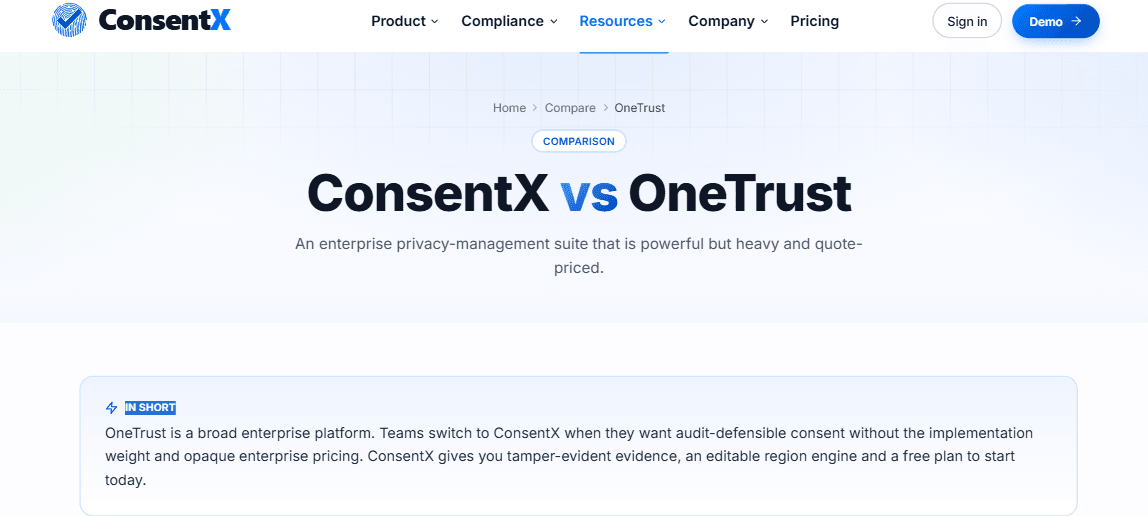
Introduction to ConsentX vs OneTrust
ConsentX is a consent management platform that helps websites and applications reach cookie compliance while respecting user rights such as the right to be forgotten. It supports GDPR, CCPA, DPDPA, LGPD and other regulations, and provides cookie banners, preference centres, regional consent rules and tamper-proof records. Non-essential cookies stay blocked before consent, and a downloadable record of each consent is generated. Because it focuses on the front end, it suits small businesses and startups that want cookie compliance without risking a privacy-law violation.
OneTrust is an enterprise trust management suite. It goes beyond cookie consent into automated evidence collection, control mapping, gap analysis and Trust Center management, covering SOC 2, ISO, HIPAA, PCI DSS and obligations across IT, HR, finance and vendor management. It is a comprehensive solution that requires a larger budget and suits large companies, financial institutions and other organisations operating internationally that must satisfy many regulations at once.
Core purpose of ConsentX
At the most basic level, ConsentX provides lightweight, privacy-focused consent management without the overhead of enterprise software. It lets you focus on your business while serving your users and complying with global privacy regulations.
Lightweight consent management
- Built to be fast and uncomplicated.
- Easy to set up, with little technical overhead.
- Straightforward dashboards for managing cookie banners and user preferences.
- Seamless integration with Google Consent Mode v2 and other standards.
These are significant advantages for startups and SMBs that want to avoid the complexity and expense of enterprise-grade CMPs while still satisfying regulators.
Privacy compliance made easy
Privacy laws such as GDPR, CCPA and India's DPDPA require businesses to demonstrate that they are not collecting personal data from users who have not consented. With ConsentX you can:
- Collect and store user consents in a way that makes compliance easy to demonstrate.
- Allow users to withdraw or update their consent.
- Keep your data practices transparent and auditable.
By focusing on the front-end side of privacy compliance, you build trust with your users.
Tamper-evident records
One thing that sets ConsentX apart from other CMPs is tamper-evident consent receipts. These serve as a reliable audit trail that cannot be altered or forged after the fact, which is what proves to a regulator that consent was genuinely obtained and never changed.
Core purpose of OneTrust
OneTrust deals primarily with enterprise compliance automation, serving large businesses with rigorous control and audit requirements.
Enterprise compliance automation
- Automates regulatory compliance processes spanning thousands of rules.
- Satisfies requirements across frameworks such as SOC 2, ISO 27001, HIPAA, PCI DSS and GDPR.
- Provides dashboards for teams to monitor compliance activity across departments.
Evidence gathering, simplified
OneTrust helps firms stay audit-ready at any moment.
- Gathers and organises compliance evidence automatically.
- Identifies gaps before they become risks.
- Reduces manual work and makes audits easier.
By centralising evidence, OneTrust saves time and builds confidence with regulators.
Branded Trust Centers
- Provides branded Trust Centers with dashboards for customers and partners.
- Improves transparency and adds to reputation.
- Turns compliance into a competitive edge by demonstrating accountability.
Frameworks supported
| Capability | ConsentX | OneTrust |
|---|---|---|
| Tamper-evident consent evidence (hash chain) | Yes | Partial |
| Editable region rule engine (no redeploy) | Yes | Yes |
| Prior-script blocking before consent | Yes | Yes |
| Google Consent Mode v2 | Yes | Yes |
| Global Privacy Control | Yes | Yes |
| DPDPA (India) §9 age-gate native | Yes | Partial |
| Built-in automated privacy scanner | Yes | No |
| DSAR workflow with SLA timers | Yes | Yes |
| Free plan | Yes | No |
| Transparent self-serve pricing | Yes | Quote-based |
On SOC 2, ISO 27001, HIPAA and PCI DSS the difference is one of kind, not degree. Those are security and governance frameworks, while both products here are about consent management, which sits in a different part of the compliance spectrum. Publicly available information does not indicate that ConsentX offers built-in support for those frameworks; it positions itself as a consent management platform, not a GRC or security compliance platform.
OneTrust supports those standards within its Tech Risk & Compliance product rather than its CMP, demonstrating alignment with SOC 2, ISO 27001:2022, ISO 27701, NIST CSF and similar frameworks. It is worth noting that OneTrust as a company is itself SOC 2 and ISO 27001/27701 certified as a vendor, which is not the same as its CMP software helping customers achieve those certifications.
Evidence handling
Both products use the phrase "audit trail", but they address two different evidence problems.
ConsentX produces a tamper-proof, admissible receipt focused on one question: can you establish that a specific individual consented to a specific action, at a specific time, under a specific version of your privacy policy?
Key features:
- Each consent action is captured in a SHA-256 hash receipt the moment it happens.
- The timestamp, the outcome and the applicable privacy rule are stored in the receipt.
- The receipt cannot be altered after the action took place.
- Each receipt covers a single consent, so it stands up when one event is disputed by a regulator or a claimant's lawyer.
- The rule engine operates in real time, so rules can change without redeploying.
OneTrust's automated evidence collection is designed for a larger, ongoing question: can the controls be verified as operating correctly across a whole review period?
Special tools and functions
ConsentX's tooling is aimed squarely at the consent-signal layer:
- Native Google Consent Mode v2 support, enabling GA4 and Google Ads signals.
- Works with Global Privacy Control (GPC) and honours browser opt-outs automatically.
- A cookie and tracker scanner that identifies trackers and surfaces compliance errors.
- Simple tag deployment with a single installation step.
- Rule changes go live without a redeploy.
OneTrust's toolkit is considerably wider, covering compliance monitoring and customer trust:
- Supports Google Consent Mode v2 and can validate IAB TCF and GPP signals.
- A Compliance Assistant that continuously checks for monitoring errors.
- Tech Risk & Compliance software for wider compliance checks.
- A dedicated place to publish certifications and reports online.
Read more: How to migrate from OneTrust without downtime.
Ease of use and target audience
ConsentX is intended for startups and SMBs. OneTrust is intended for enterprises and highly regulated industries.
ConsentX is meant to get teams running quickly without a lengthy enterprise sales cycle. It is self-serve, with straightforward pricing and a generous free tier, installable with a single tag, and region-specific consent rules can be edited live without engineering resources. Rapid deployment, a low entry cost and a UI built for light-touch configuration are why it fits teams that need a pragmatic GDPR, CCPA or DPDPA solution deployed this quarter rather than in two years.
OneTrust, by contrast, addresses enterprises and regulated industries such as healthcare, finance and pharma, which need end-to-end privacy, security and risk management. The entry threshold is high, with enterprise sales cycles and a multi-month implementation.
OneTrust spans the whole GRC lifecycle, covering more than 300 privacy regimes and 50+ security and compliance frameworks across 50+ jurisdictions, with extensive role- and attribute-based access control, customer-managed encryption keys and sandbox environments.
Pricing models
ConsentX is fully self-serve, with transparent, non-negotiable billing and a free plan that covers a real level of compliance.
OneTrust's free plan is limited. Paid tiers start at $99 per month, and full enterprise contracts typically begin at $10,000 or more per year, with a complex and lengthy implementation process.
Pros and cons
ConsentX is easy to set up and affordable. It provides tamper-evident consent receipts and a UI that non-experts can operate, so organisations needing GDPR, CCPA or DPDPA compliance quickly benefit from it. It covers privacy regulations only, not frameworks such as SOC 2 or HIPAA, which makes it a fit for small and medium businesses rather than enterprises.
OneTrust suits large organisations: it automates compliance across many regulations, supplies the evidence audits require, and provides a Trust Center that strengthens reputation. Its entry-level plan is weaker than others reviewed, and it demands heavy investment of both money and time, since contracts are expensive and setup takes several months. That makes it a better choice for big companies than for small startups.
Conclusion
The choice between ConsentX and OneTrust comes down to your business size and compliance needs.
ConsentX is the right fit for startups and SMBs. It is quick to set up, affordable, and covers the key privacy laws including GDPR, CCPA and DPDPA. Lean teams can go live fast without dedicated IT or compliance staff.
OneTrust is built for large enterprises and regulated industries. It offers deep compliance automation, evidence collection and support for 50+ frameworks. It requires more time and investment, but delivers the scale and governance power large organisations need.
Get started with ConsentX free.