
What is a consent management platform (CMP)?
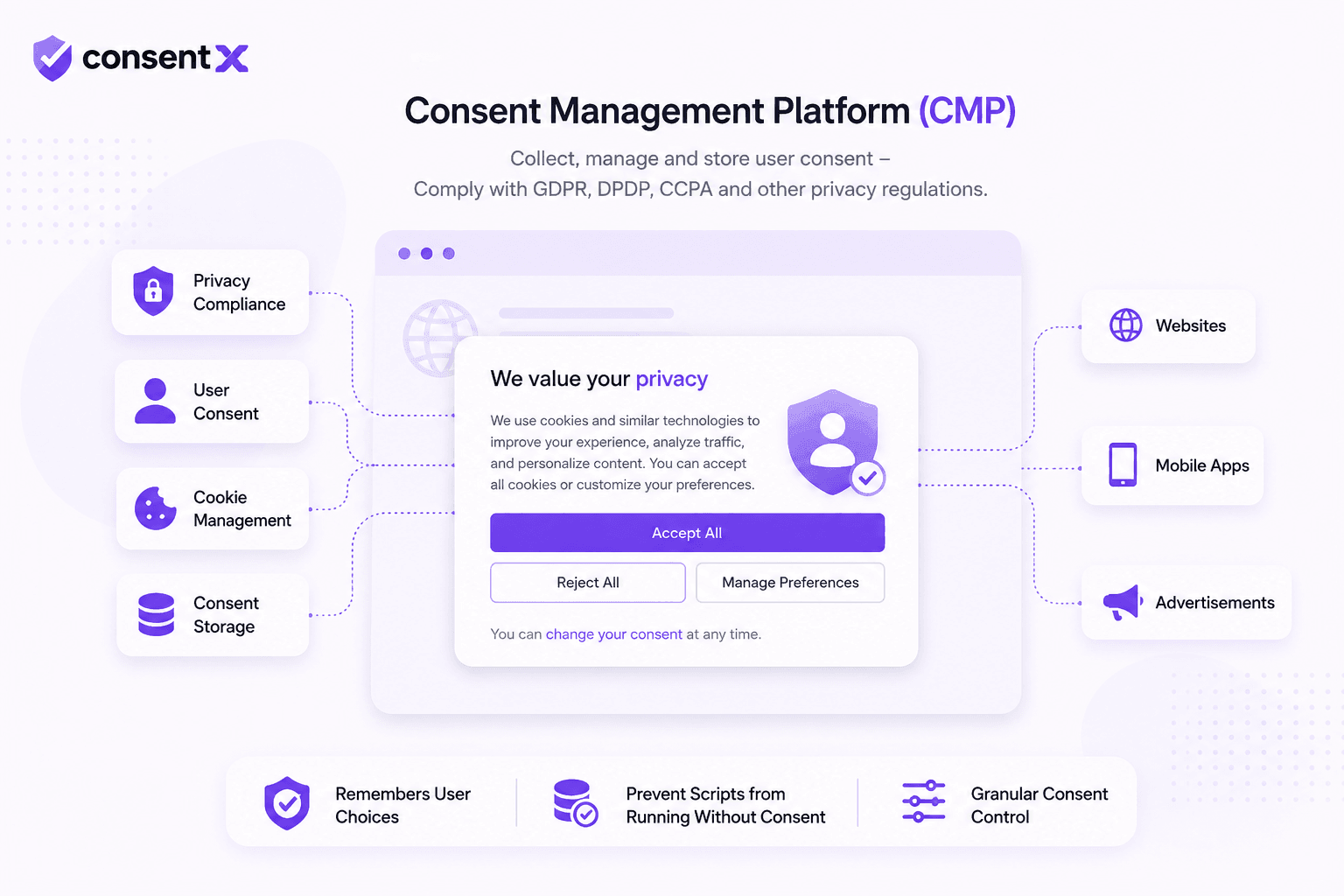
A consent management platform is a privacy tool that helps a business collect, store and honour a person's permission to process their personal data. Most people meet a CMP as the cookie consent banner that appears on a website. A visitor arrives, is told what would be stored on their device and by whom, and is offered a genuine choice to accept or reject it.
Websites are only the most visible case. Mobile apps and advertising platforms use CMPs for the same reason: to inform people and obtain a lawful basis for collecting their data under the GDPR, the DPDP Act, the CCPA and dozens of other regulations.
What often gets missed is that a CMP does far more than ask the question. It remembers the answer, and it stops any script that would violate that answer from running on the visitor's device. It also lets people choose at the level of a purpose or a category, rather than forcing a single all-or-nothing decision about every tracker on the page.
That combination is what makes a CMP a serious tool rather than a decoration. It is how a company that genuinely values its users' privacy collects personal data lawfully and still improves its product.
Why is consent management important?
Consent management matters because personal data is valuable to the people it belongs to, and they increasingly want to control who gets it. A single bad experience with how a company handled their data can end that relationship permanently. On the legal side, businesses that manage consent poorly face fines that are painful even for small and medium companies.
There are really two reasons to invest in a proper consent solution: reducing legal risk, and earning trust.
The legal reason is straightforward. Privacy laws require a valid lawful basis, and for most tracking that means clear, freely given consent that you can prove afterwards.
The trust reason is quieter but compounds. People decide who to share data with based on whether they believe the company will treat it well. Give them a clear, honest choice and an easy way to change it, and you are one of the companies they keep dealing with.
How does a consent management platform work?
A CMP is a set of connected parts working in real time at different layers of your stack.
Visitor
arrives on your site or app
Website or application
the page loads, non-essential scripts stay held back
Consent banner
notice and choices matched to the visitor's region
User choice
accept, reject, or allow specific purposes
Consent management platform
enforces the decision and releases only what was allowed
Consent record
the choice is stored with the notice version shown, as evidence
Marketing, analytics and other tools
receive the consent state and act within it
Privacy protection
The moment a visitor lands on your page, the CMP identifies where they are. Based on the rules that apply in that region, it shows the appropriate notice and choices. Crucially, before the visitor decides, the CMP holds back every non-essential script and tracking call on the page. That is what lets someone make a choice without already having been tracked while they made it.
Early cookie tools did not do this. They showed a banner while the trackers ran anyway, which is exactly the pattern regulators now fine. Holding tags until the visitor decides is what prior-script blocking means in practice.
Preference management
Once a choice is captured, the visitor carries on browsing and the CMP stores what they agreed to, so it can be produced later if anyone asks. Good platforms sync that state across the rest of your tools, including your CRM, email platform and analytics, so one system is not still processing data that the person has withdrawn. Visitors can update their preferences at any time, and the change takes effect immediately without breaking the page.
A privacy gateway
The most useful way to think about a CMP is as a control point at the front door of your organisation, deciding what may be collected from each visitor. It usually works through a single snippet of code on your pages, with your other tools registered behind it. Adding a new tool then becomes a configuration change rather than an edit to hundreds of lines of markup across every template. For a team maintaining privacy settings across several sites or brands, that alone is worth the switch.
Key features of a modern CMP
Not every consent tool is equal. These are the capabilities a cutting-edge consent management platform should have.
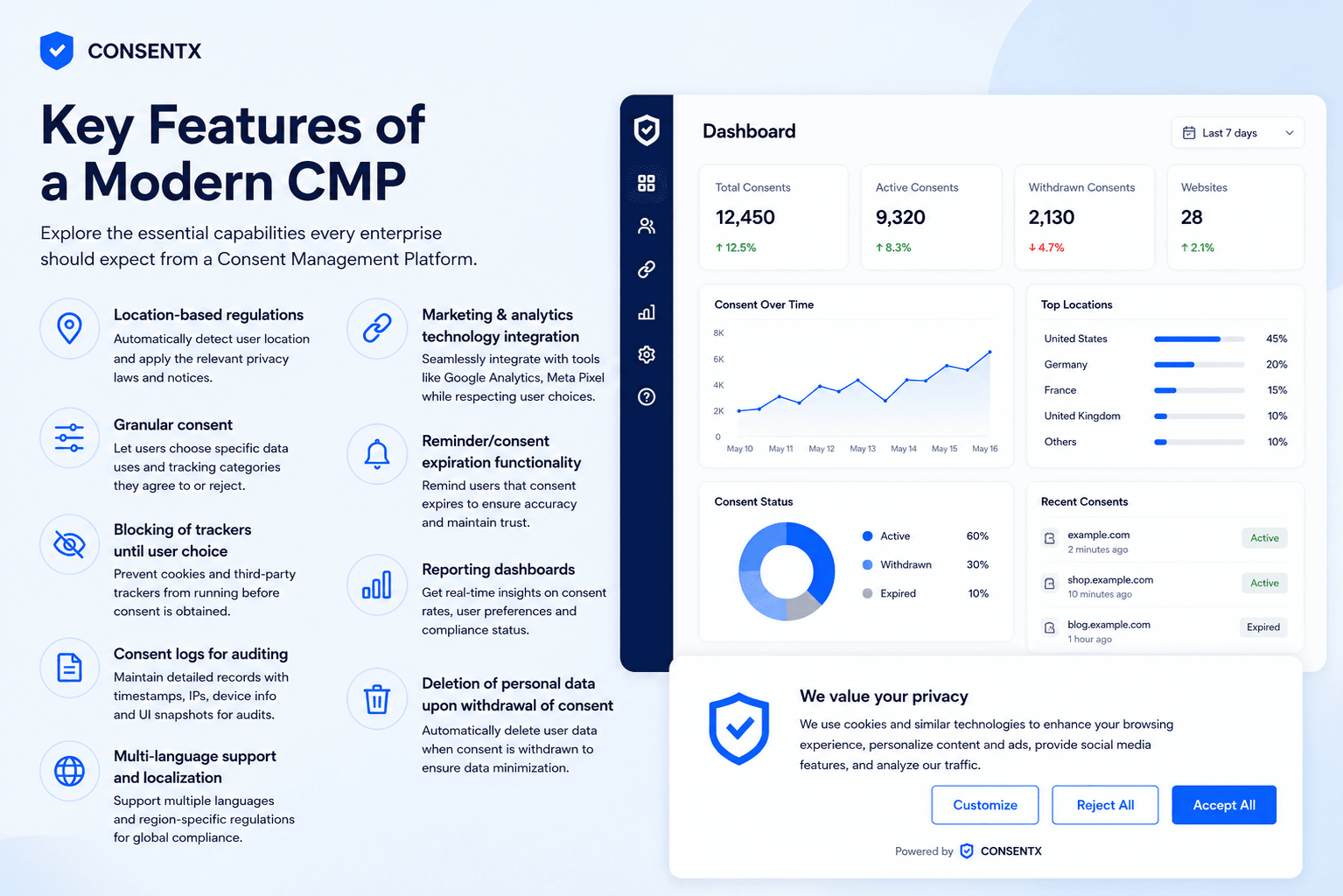
- Location-based rules. The platform should recognise where a visitor is and apply the law that governs them, because consent requirements differ sharply between regions.
- Granular consent. People should be able to allow analytics but refuse advertising, rather than being pushed into accepting or rejecting everything at once.
- Blocking of trackers until a choice is made. No non-essential script, first-party or third-party, should run before the visitor decides. Under most consent laws, that is what prior consent means.
- Consent logs for auditing. Detailed records of each choice, including timestamp, the notice version shown and the state of the interface, so the consent can actually be evidenced.
- Multi-language and localisation support. International traffic means notices in the visitor's language and terms matched to their jurisdiction.
- Marketing and analytics integrations. The CMP has to talk to the rest of the stack, limiting what tools like Google Analytics or the Meta pixel are allowed to collect for each visitor.
- Consent expiry and re-prompting. Consent does not last forever. A good platform asks again on a sensible schedule instead of relying on a decision made years ago.
- Reporting dashboards. Privacy officers and owners need to see opt-in and opt-out rates, spot unusual patterns and confirm that the traffic they are processing is actually consented.
- Deletion on withdrawal. When someone revokes consent, the better platforms can also trigger deletion of the personal data collected under it, which matters if you want to retain nothing beyond what people permit.
A tool missing several of these will be limited in how far it can actually protect your users, whatever the marketing page says.
Challenges of managing consent without a CMP
Organisations that handle consent manually, or with a tool that only draws a banner, tend to hit the same problems.
- Inconsistent enforcement. Cookies get dropped before consent, which defeats the entire principle. This is very hard to catch by hand once a site carries hundreds of scripts added over years of development.
- No central documentation. Manual approaches leave no audit trail showing exactly what a given person agreed to in a given session. When a regulator asks, the answer needs to arrive quickly.
- No way to scale globally. Every region has its own rules. Keeping banners and policy text correct and consistent across all of them by hand is slow and error-prone.
- Unreliable data. When opt-outs are not honoured properly, analytics and marketing numbers stop reflecting reality, and decisions get made on top of them.
- Higher regulatory risk. Authorities have hardened their stance on consent violations. Being unable to demonstrate verifiable consent is itself a significant exposure.
- Poor user experience. Non-compliant banners confuse and irritate people, especially when withdrawing consent is harder than granting it. That costs engagement and brand goodwill.
- Wasted engineering and compliance time. Developers and compliance staff end up hand-managing scripts, checking behaviour and processing requests that should be automated.
- Slow response to withdrawal. Where revocation is handled manually, tracking can continue for days or weeks afterwards, collecting data the person has explicitly refused.
Smaller sites are not exempt from this. If anything the case for automating early is stronger, because the gaps only get more expensive to fix once traffic grows.
| Without a CMP | With a CMP |
|---|---|
| Cookies drop before consent, and nobody notices | Non-essential scripts are held until a choice is made |
| No audit trail of what each person agreed to | Every choice recorded against the notice version shown |
| Banners and policy text maintained by hand per region | Region rules applied automatically as visitors arrive |
| Opt-outs missed, so analytics stop reflecting reality | Only consented data enters your systems |
| Withdrawal takes days or weeks to take effect | Withdrawal applies immediately across connected tools |
| Developers and compliance staff manage scripts manually | One platform handles enforcement and record keeping |
Benefits of using a consent management platform
Some of the gains are legal, some operational, and some are about the relationship with your customers.
- Regulatory alignment. A capable CMP helps you meet GDPR, DPDP Act and CCPA requirements and reduces the risk of costly violations.
- Trust. A clear interface where people can see and adjust their privacy preferences signals that their choices are taken seriously.
- Cleaner data. Blocking collection from people who have not consented keeps unlawful data out of your systems in the first place.
- Defensible evidence. Demonstrating compliance is far easier with proper consent records, which is what matters during an audit or a dispute.
- Easier expansion. Entering a new market is a configuration change rather than a bespoke consent build for each region.
- Efficiency. One platform removes a lot of repeated manual work from legal, marketing and analytics teams.
- Better marketing. Marketers get targeting data they can rely on, with confidence that they are not using data they were never permitted to use.
- Competitive positioning. As privacy expectations rise, companies whose choices are easy to understand stand apart from those whose are not.
- Partner requirements. Many ad-tech vendors, networks and partners now require proof of consent before they will work with you.
Who should use a CMP?
A CMP is not only for large corporations with in-house legal teams.
E-commerce stores handle payment and customer data and need to show that every piece of personal information was collected lawfully.
Software and technology companies process user data at scale, online and offline, and need a compliance model that keeps up with that volume.
Healthcare and financial services hold some of the most sensitive data there is, under some of the strictest rules, where both security and lawful processing are non-negotiable.
Media and publishing businesses depend on advertising and traffic, so their ad practices have to be lawful and transparent to readers.
Marketing agencies manage consent on behalf of several clients across many domains, and need one place to keep track of it.
Startups and small businesses often assume a CMP is overkill. But if your site collects personal information at all, you are in scope, and a small company is usually the least able to absorb a fine.
Any business operating internationally needs one, because consent rules vary enormously by jurisdiction and a single global cookie policy rarely satisfies all of them.
Educational institutions and non-profits handle data belonging to students, staff and donors, and are held to the same transparency standards as anyone else.
Real estate and rental companies hold contact and financial details that require both careful security and clear consent before any third party sees them.
How ConsentX simplifies consent management
ConsentX exists to take the moving parts out of this. Instead of stitching together separate banners, scripts and policy documents, you get one platform that detects a visitor's region, applies the relevant legal terms, and only permits tracking that the law and the visitor both allow.
Non-essential third-party scripts and trackers are blocked automatically until consent is given, so prior blocking is the default rather than something you have to audit for. Every choice is captured and documented as it happens, which means producing evidence for a regulator is a lookup rather than a project. The cookie notice itself tells people plainly what is being collected, so the consent you hold is informed consent.
Automated compliance, in practice
Rather than configuring tracking rules visitor by visitor, the platform adapts the notice to each person's location and preferences on its own. The same consent state works across your website, apps and marketing channels, and the multi-language support means entering a new market does not require rebuilding your consent layer. The point of the automation is simple: stay lawful continuously, and spend your time on the rest of the business.
Why businesses need a CMP in 2026
The privacy landscape has shifted, and the cost of not adapting has gone up.
Regulators enforcing the GDPR, the DPDP Act, the CCPA and their equivalents now look specifically at whether an organisation has real consent management in place, and they are willing to fine those that do not. New laws keep arriving, and tracking all of them across every jurisdiction by hand is no longer realistic.
Customers have changed too. They expect meaningful control over their data, and they notice when it is not offered. Companies that withhold that control lose to privacy-forward competitors.
Browsers have moved as well. As third-party cookies disappear and first-party data becomes the foundation of measurement, the businesses without a consent layer lose their lawful route to the data they need. The rise of AI adds to the pressure, since these systems are data-hungry and regulators are watching how that data was obtained.
Consent management is becoming table stakes. Before long, not having it will look less like a cost saving and more like a red flag.
How a CMP differs from a cookie banner
These two get confused constantly, and the difference matters.
A cookie banner is an interface element. It tells a visitor that a site uses cookies. In many implementations it is misleading, because the site continues to track behaviour regardless of what the visitor clicked, which is precisely what the law prohibits. The banner is one small part of a much larger system.
A consent management platform does considerably more. It actively controls collection instead of merely requesting permission. It records every choice in detail. It adapts what is shown and what is allowed based on region and preference. And it lets people make specific choices rather than one blunt one.
The second big difference is reporting. Most standalone banners report nothing. A CMP shows you opt-in and opt-out rates, how choices break down by category and region, and where your exposure sits.
A cookie banner is a please-knock sign on the door. A consent management platform is the lock, and the record of everyone who tried the handle.
Conclusion
Consent management has become a core part of running a business that touches personal data. A platform like ConsentX helps you collect valid consent, comply with the regulations that apply to you, and prove it afterwards. Beyond compliance, it builds the trust that makes data easier to manage and growth easier to sustain, locally and internationally.
The companies still standing at the end of 2026 will be the ones that treated privacy infrastructure as infrastructure. See what fires on your own site before consent, or start building trust and compliance today with ConsentX.