
Introduction
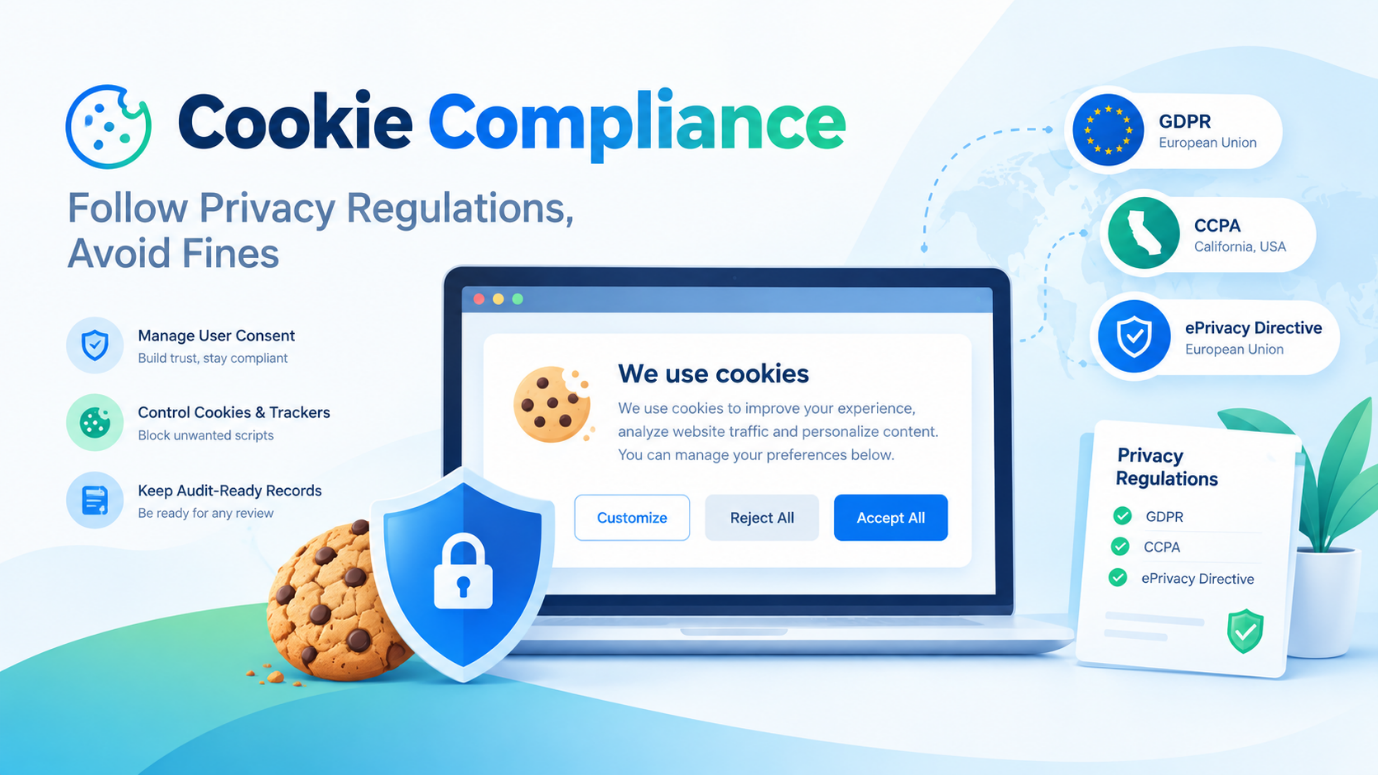
If you have ever been a website owner, chances are you have heard something about cookie compliance and the various privacy regulations it entails. But what exactly is it and why should you care? In short, cookie compliance can be described as legality surrounding the collection, storage, and processing of cookies on one’s website. Now, I understand what you are thinking, cookies are used to track our behavioral patterns and are crucial to the functioning of advertisements, but they do involve the collection of personal data which is why cookie compliance falls under the category of privacy regulations.
Privacy regulations such as GDPR, CCPA, and ePrivacy Directive are laws that make cookie compliance mandatory and if not followed can result in heavy fines and a loss of your organization’s reputation.
Why Is Cookie Compliance Important
Cookie compliance is an integral practice that websites employ to gain and preserve user trust. The violation of any rules and regulations by a business reduces the level of trust exhibited by customers. Meanwhile, the effective establishment of a website’s commitment to cookie compliance enhances the willingness of the visitors while also contributing towards legal and business goals. These aspects are discussed below in-detail.
- Avoid large fines Authorities can levy substantial fines on enterprises that are not compliant with the cookie compliances guidelines, which is useful for sustaining a business.
- Increases trust and confidence Most users choose to work with companies that they trust. Through trust, visitors can also be encouraged to provide their personal data willingly.
- Enhanced image Enterprises that practice enhanced privacy rules are often preferred among consumers.
- Maintaining a safe website Compliance with the cookie compliance rules and regulations is necessary to avoid litigation against an organization.
- Ensures global operation Any website engaging international audiences can rely on cookie compliance to meet the data privacy rules of each region.
From this perspective, it would be essential for businesses to recognize that cookie compliance should be institutionalized as a core procedure. With regard to the long-term benefits of compliance, an organization would be in a position to achieve substantial savings in terms of legal and public relations costs. Therefore, businesses should consider compliance as a critical criterion to achieve long-term economic goals.
What Are the Main Cookie Compliance Rules?
While each law may have its own specifics, most cookie compliance rules concern several broad concepts. Regardless of the country of your customers’ location, they are likely to be the basis for any privacy regulation, so it is essential to learn them in detail.
- The necessity of consent aside from cookies that are strictly necessary for the website operation, you should acquire user consent before storing or accessing any information.
- Providing information about the cookies the user should be informed about the purpose, storage duration, and any other relevant data.
- The right not to accept technical consent should be given voluntarily in all cases.
- With easy withdrawal of consent a user should be able to change their mind and withdraw their consent at any time.
- Providing proof of consent technically, always store the data proving the fact and the date of a user’s consent.
- Keeping the policies up to date make sure that the information provided on your website is current and relevant.
These are the main concepts related to cookie compliance laws. Having understood them, one can proceed to develop a cookie compliance strategy for their website or application.
What Are the Types of Cookie Compliance?
| Type | How It Works | Common Legal Basis |
|---|---|---|
| Opt-in Compliance | Users must actively agree before any non-essential cookie is placed | GDPR |
| Opt-Out Compliance | Cookies are placed by default, with the ability to opt out at a later time | CCPA |
| Category-Based Compliance | Cookies are grouped (necessary, functional, analytics, marketing) which allow users to give consent per category | Various Global Frameworks |
| Granular Compliance | Users can accept or reject individual cookies | Highest Standard Of User Control |
| Region-Based Compliance | Cookie banners and consent models change based on the location of the visitor | Adapts To Local laws (GDPR, CCPA, ETC) |
Cookie compliance cannot be selected arbitrarily; it depends on the type of cookies used, the location of the website visitors, and the list of rules that need to be followed. In particular, websites that operate in the jurisdiction of the GDPR require the use of opt-in compliance. This means that no analytical, advertising, or other unnecessary cookies can be placed on the visitor’s device without their consent.
At the same time, the CCPA compliance guideline allows for the use of opt-out consent, which involves placing all necessary cookies on the user’s device by default and allowing them to disable specific types of cookies. Another approach is to use category-based compliance which focuses on dividing cookies into several types (necessary cookies, functional, analytical, and marketing) and only these categories are used for consent.
Finally, a granular level of compliance implies individual consent for each cookie, while the region-based method refers to the location of the user. The appropriate method of cookie compliance should be chosen based on the location of the website visitors and the legal requirements that the website has to meet.
What Are The 4 Key Components Of Cookie Compliance?
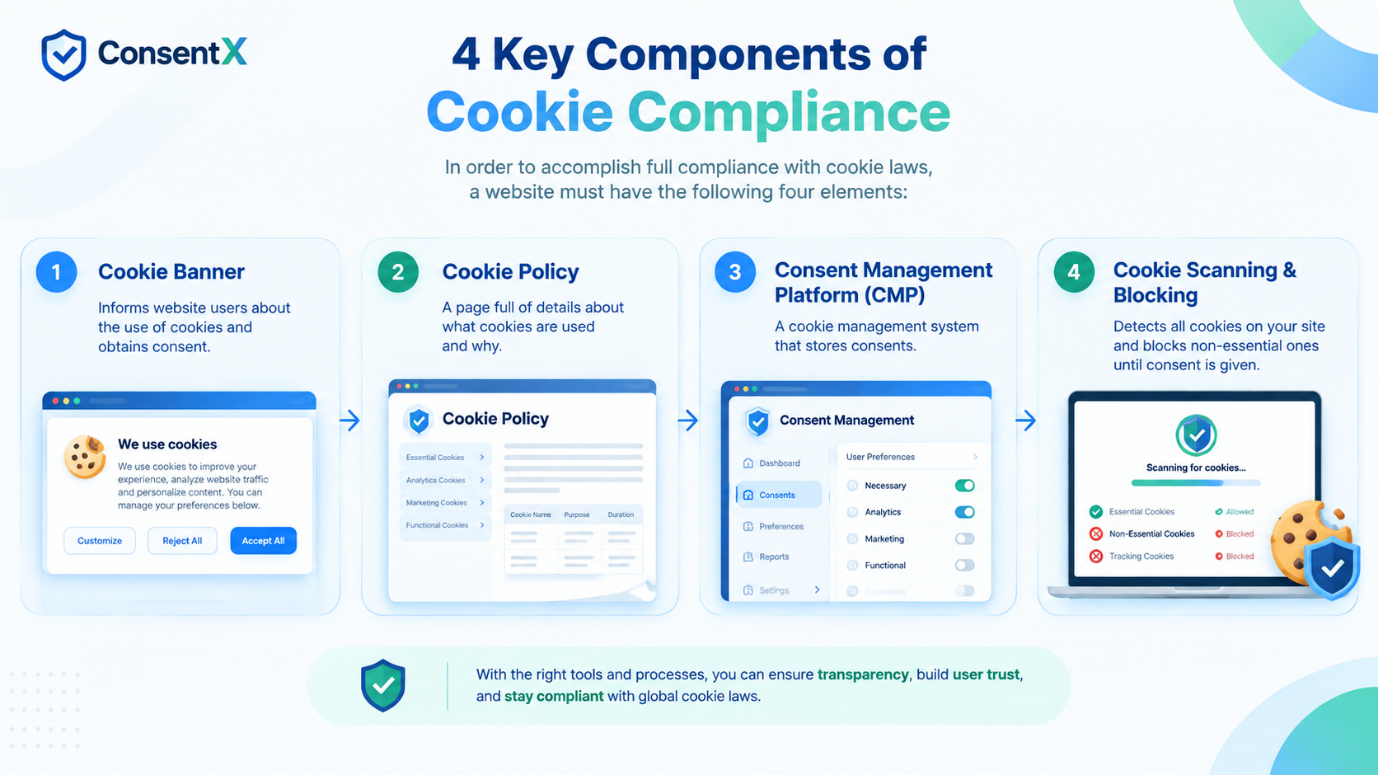
In order to accomplish full compliance with cookie laws, a website must have the following four elements:
| Components | Purpose |
|---|---|
| Cookie Banner | Informs website users about the use of cookies and obtains consent |
| Cookie Policy | A page full of details about what cookies are used and why |
| Consent Management Platform (CMP) | A cookie management system that stores consents |
| Cooking Scanning & Blocking | Detects all cookies on your site and blocks non-essential ones until consent is given |
It must have a cookie consent banner, which will ask for the visitor’s permission before storing any non-essential cookies on their device. One of the most common mistakes that companies make is the reverse approach: they load the cookies on the user’s device before asking for consent.
A site must have a cookie policy. It is a page with a list of all the cookies that the site stores on the visitor’s device and the purpose of each cookie. The third requirement is a CMP – a consent management platform. With CMP, users can easily manage their cookie preferences at any time. Some privacy laws even require websites to have such a platform.
The last element which is often overlooked is a cookie scanning tool. Websites often get new cookies without anyone’s knowledge. That is why regular scans are required to ensure that no cookies are stored without the visitor’s consent.
Which Laws Require Cookie Compliance
Several privacy laws in different parts of the world require cookie compliance. The table below contains the most influential regulations in this area.
| Law | Region | Key Requirement |
|---|---|---|
| GDPR (General Data Protection Regulation) | European Union | Requires Clear Consent Before Setting Non-essential Cookies |
| ePrivacy Directive (Cookie Law) | European Union | Requires Website To Inform Users and Consent for Cookies |
| CCPA/CPRA | California,USA | Requires an option to opt out of the sale of personal data via Cookies |
| LGPD | Brazil | Requires Consent For Data Processing, Including Cookies |
| POPIA | South Africa | Requires Lawful Processing of Personal Information, Including Cookie Data |
| PIPEDA | Canada | Requires Meaningful Consent For Data Collection Through Cookies |
For businesses, this means that they have to be cookie compliant in the countries they operate. And since most companies have visitors from various regions, it is safer to follow the regulation that is the strictest about cookies. The GDPR compliance standard, for example, covers most of Europe and is, therefore, a common standard to follow.
The cookie compliance laws are also subject to continuous changes and updates in different regions. A company has to remain cookie compliant at all times, which means double-checking rules on a regular basis. In other words, cookie compliance should be a perpetual task on a business’s todo list.
What Are the GDPR Requirements for Cookie Compliance?
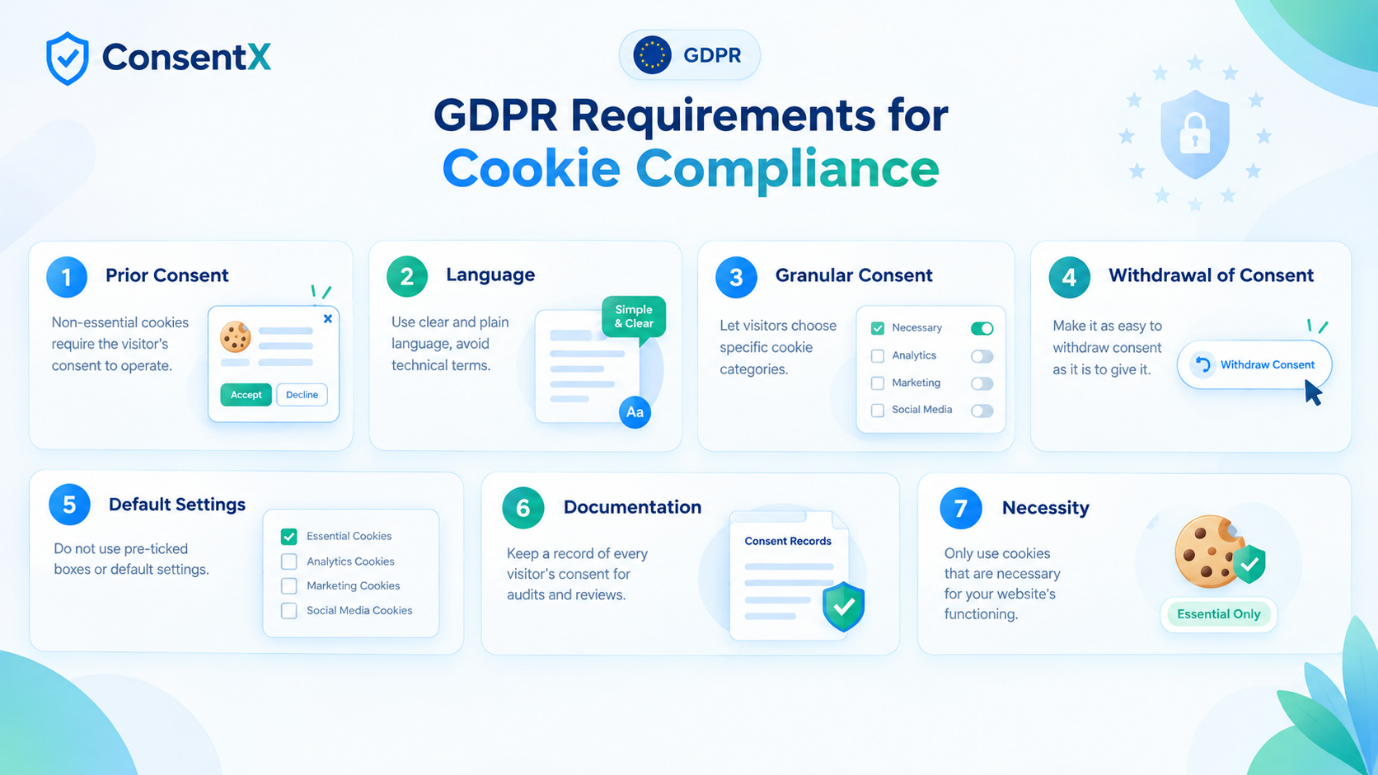
GDPR defines several regulations in relation to cookies. These include:
Prior Consent Non-essential cookies require the visitor’s consent to operate. This includes but not limited to analytic cookies, targeting/retargeting cookies, and social plug-in cookies. Only essential cookies can be used before consent.
Language The information must be provided in clear and plain language. Avoid using technical terms that a non-professional person may not understand.
Granular Consent organizations must make it easy for the visitors to consent to specific categories of cookies. The GDPR-compliant cookie consent banners must offer options instead of a generic opt-in checkbox.
Withdrawal of Consent The procedure for withdrawing the consent must be as simple as the initial consent. A link that says “withdraw consent” that is hidden or difficult to find will not be sufficient to satisfy the GDPR compliance.
Default Settings Consent banners must not contain pre-ticked boxes or any other default settings. Banners that give the impression of “consent by default” are not allowed under the GDPR regulations.
Documentation The website must be able to document every visitor’s consent to GDPR-compliant cookie tracking. This documentation must be available in case of regulatory review or audit.
Necessity The companies can only use cookies that are necessary for the functioning of their websites. They cannot install any additional cookies without a legitimate and demonstrable reason.
How to Become Cookie Compliant: A Step-by-Step Guide
If your website uses cookies, you may be bound by data privacy laws – most notably the GDPR and ePrivacy Directive. Failure to comply with these regulations can result in significant financial penalties as well as reputational damage to your brand. Fortunately, there are concrete steps you can take to ensure cookie compliance.
- Identify your website’s cookies The first step is to conduct a comprehensive audit and categorize all the cookies used on your website. There are several types of cookies including strictly necessary cookies, functional cookies, performance/analytics cookies, and advertising/marketing cookies. For each type of cookie, you should specify its purpose, retention period, and whether it is a first-party or third-party cookie. This audit should be repeated on a regular basis, as third-party services can often be added without your knowledge.
- Determine which privacy laws apply to your website Cookies are subject to data privacy laws depending on the jurisdiction of the users you are targeting. The GDPR and ePrivacy Directive (which apply to businesses operating within the EU/UK) require websites to get user consent before storing non-essential cookies, while the more recent CCPA/CPRA (which applies to residents of California) require an “opt-out” mechanism for the sale of personal information. Other jurisdictions such as Brazil’s LGPD, Canada’s PIPEDA and several others also have their own cookie-specific regulations. When unsure, always configure your cookie compliance solution for the most rigorous set of standards.
- Publish a cookie policy in your privacy center Your cookie policy must be published as a standalone page (ideally in your website’s footer) and include information about each type of cookie, such as their purpose, storage duration, and any third-party analytics or marketing services that may place cookies on your website domain.
- Display a cookie consent banner This banner must disable any non-essential cookies by default pre-checked boxes or consent banners that utilize “I accept by browsing” language are not considered compliant with the GDPR. Always display both accept/reject buttons in equal proximity, avoid using behavioral nudges or “dark patterns” to encourage consent, and consider adding granular controls so users can accept some categories of cookies while rejecting others.
- Invest in a CMP (Consent Management Platform) A CMP will help you ensure cookie compliance by automatically disabling scripts until consent is given, storing timestamped proof of consent, and helping you maintain up-to-date records and cookie inventories.
- Honor the choices made by website visitors Getting consent from your website visitors is not sufficient you must configure your website in such a way that it actually honors those choices. This means making sure tracking scripts such as Google Analytics or Google Tag Manager do not execute if the user has declined cookies, and providing a way for users to manually update their consent at any point in the future.
- Update your privacy policy Your general privacy policy should include a description of the personal data your website processes and how that data is used, along with details about users’ rights and any potential data subject requests.
- Maintain records of consent The various data privacy laws and regulations require businesses to maintain records of consent. Ideally, this information should be available in an organized manner at all times, so that law enforcement agencies can request it quickly.
- Train your staff to avoid policy violations Marketing teams and developers should understand the potential repercussions of violating cookie compliance laws and should always ensure new software or third-party services do not add non-essential cookies to your website.
- Conduct regular cookie compliance audits It is good practice to conduct a cookie compliance audit on a quarterly basis or whenever major updates are made to your website. In addition, always keep track of any regulatory changes that may affect your jurisdiction.
Conclusion
Cookie compliance is a hot topic right now, and for good reason. Websites that collect visitor information need to ensure they are cookie compliant. This is vital in protecting the users of your site, and in protecting yourself legally. After all, non-compliance could cost you dearly. To summarize, cookie compliance falls under the following categories: consent, policies, cookie categorization and monitoring. The GDPR, CCPA and ePrivacy Directive regulations all contribute to the importance of first-party and third-party cookies.
Maybe you feel overwhelmed by the idea of handling cookie compliance on your own.
Get Started with ConsentX