
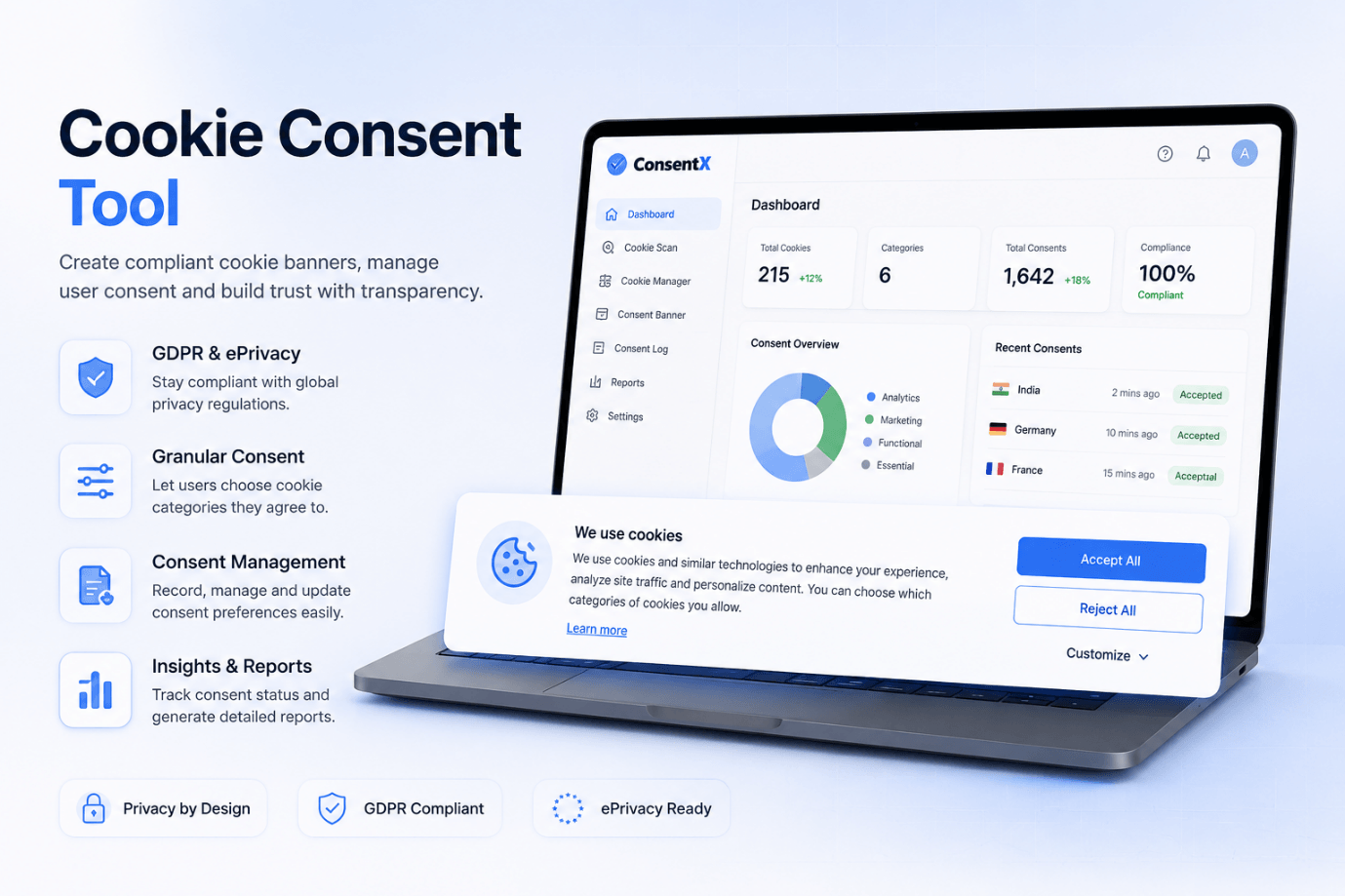
Cookie consent is something that has been widely seen before. When visiting various sites, there is often a message popping up saying "Accept our cookies." As inconsequential as it may seem, cookie consent is actually quite vital today. It is not only about compliance with various privacy laws, but also preserving the privacy of customers and establishing mutual trust between users and websites.
To put it simply, the cookie consent grant is gaining the rights to use particular cookies with the permission of visitors themselves. Cookies can be understood as tiny files that are kept on clients' devices. What they do is help websites remember account passwords, monitor customers' activities, improve work of websites, and target advertisements.
If such consent is not obtained, it is possible for sites to obtain and use certain information on clients without informing them, so the practice may become quite controversial if not illegal.
What Is a Cookie Consent Tool and How to Choose the Right One
A cookie consent tool is basically a type of software. It is meant to help a website gain consent from visitors. Also, it is responsible for storing and managing that consent. Otherwise, it would be necessary to create a pop-up from scratch and manually keep track of every visitor's choice.
The way cookie consent tools operate is pretty simple. A visitor visits your website. The cookie consent tool immediately blocks all the cookies that are not really necessary. After this, a banner appears on the screen on the top or at the bottom. In that banner, it is possible to learn everything about the cookies and get the options of "Accept all," "Reject all" and "Manage preferences." Once the visitor chooses one of these options, the cookie consent software saves that option and makes sure that the only cookies that are downloaded are the ones that the visitor is allowed to load.
There are many tools on the web and it is not always easy to select the best one. Here are some things you have to think about before selecting a cookie consent tool:
- Compliance with laws: The tool must be compliant with legislation such as the GDPR and CCPA.
- Adaptation: The banner needs to adapt with the design of your website.
- Ease of use: The configuration should not be a challenge even for people who are not tech-savvy.
- Automatic scanning: The tool must be able to find all cookies and categorize them.
- Logging consent: The tool should keep track of everything the user has selected. This comes handy when auditing.
- Support for different languages: If there are visitors from various countries, the banner needs to have a function that allows it to speak different languages.
Using the right tool saves time and decreases the legal risks.
Why Is Cookie Consent Important?
There is more to this issue than just a legal standpoint. Here's why this is important:
It preserves privacy. If a website tracks a user without asking, it collects their information without their permission. Asking beforehand gives users the ability to control that process. They tell a website what information is collected and what is not.
It creates confidence. A clear and honest banner sends a signal to users that their privacy is respected. This can go a long way in improving your public image. Those who track people without their consent tend to lose trust very quickly.
It protects you legally. Many countries now have stringent privacy legislation. When they are violated, large fines are inevitable. Doing things the right way protects your business from such cases.
It increases transparency. Asking for permission obliges a website to be frank. It must explain what type of information is collected and why it does so. This is good for both parties involved.
It improves your marketing information. If users never gave permission, there is a possibility that your data is incorrect. Tools such as Google Analytics require a clean source of data in order to function properly.
Essential Cookie VS Non Essential Cookie
There are two primary cookie classifications. It is very important to differentiate between them as they are subject to different regulations.
Essential cookies help the website function properly. They do not require any prior consent.
Some examples include:
- Cookies that save items in carts
- Cookies that enable log in access
- Cookies that provide safety and prevent fraud
- Cookies that regulate the traffic
Without essential cookies, basic functions fail. Visitors will not be able to log in, make purchases or browse the website securely.
Non-essential cookies are not obligatory for the site to function completely. They are the kind of cookies that require a clear consent from the user in the first place. They usually fall into several categories:
- Analytics cookies: Allow you to get information about how visitors use your site.
- Marketing cookies: Help display personalized ads based on visitors' interests.
- Functional cookies: Remember small details, like language preference.
- Social cookies: Allow sharing buttons and embedded content to work properly.
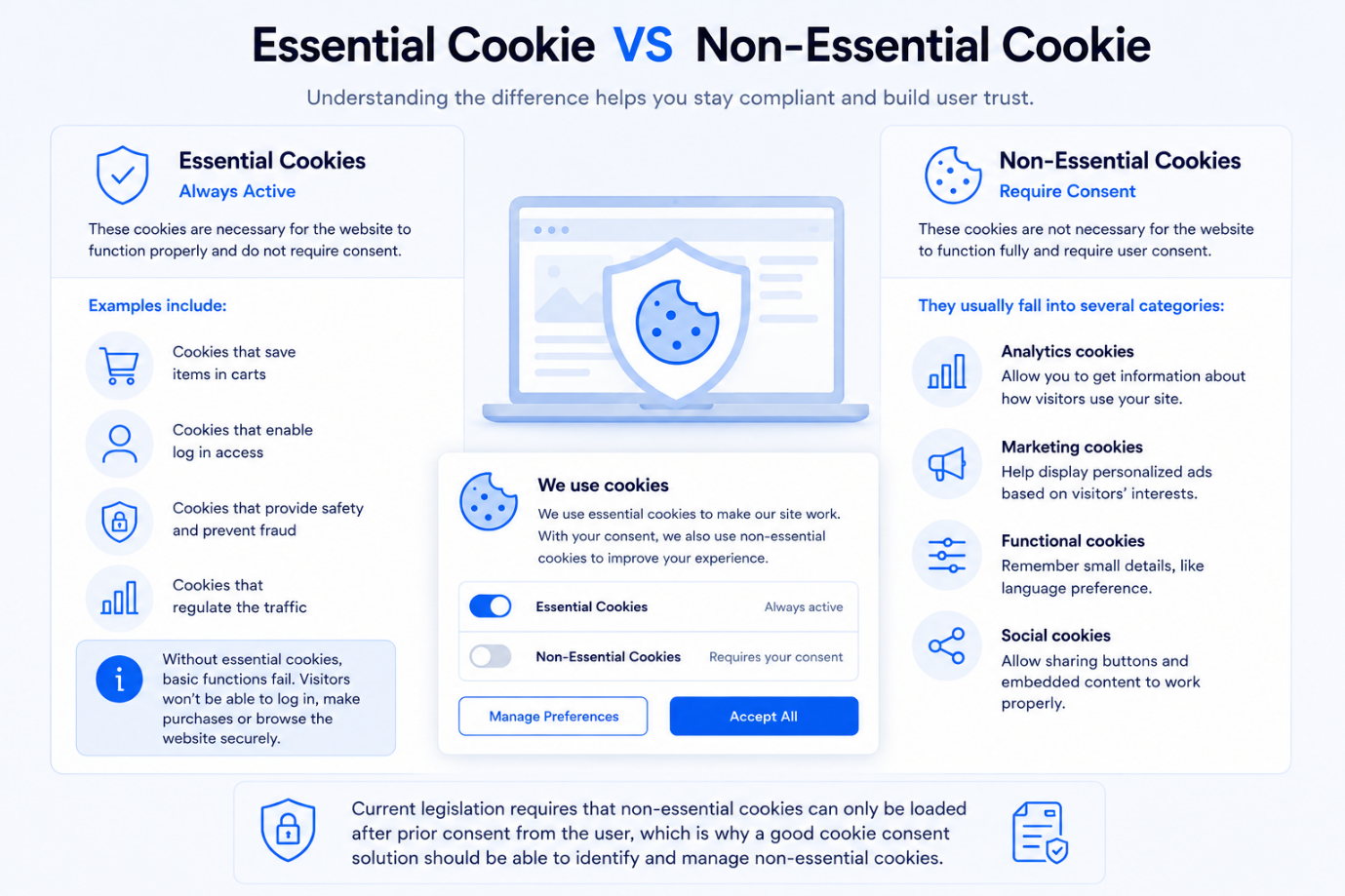
Current legislation requires that non-essential cookies can only be loaded after a prior consent from the website user, which is why a good cookie consent solution should be able to sort non-essential cookies.
Cookie Consent Law Standard To Follow
There are a few major laws governing this. It helps to be aware of them.
- GDPR (General Data Protection Regulation): This is one of the toughest privacy regulations available and is to be complied with if you have any EU-based visitors. By default GDPR requires clear, freely given consent to the collection of information and visitors must opt in (pre-ticked boxes are not legal and the option to opt out must be as easy as opting in).
- EPrivacy Directive (commonly known as the 'cookie law'): Similar to GDPR in scope this is to be used in conjunction with the GDPR and has focused upon cookies. It demands you need user permission before installing or accessing cookies from their device (bar strictly necessary cookies).
- CCPA and CPRA (California regulations): These regulations grant residents of California the right to know information being gathered about them. They can also demand their information cannot be sold. They are not like GDPR in that they do not require the "consent banner". They do however require that website owners provide a clear link stating that the resident does not want their information sold.
- LGPD (Brazil): This Brazilian regulation is similar to GDPR in demanding clear permission before websites can take out any personal data via any cookies.
- PIPEDA (Canada): Similar to both other regulations Canada's privacy laws request websites to have transparency regarding their data usage including what cookies the website possesses.
Even when sitting outside the areas specified above it is still to be noted that these regulations apply to individuals of all areas when using the website; therefore for a country to only consider the usage of sites used outside of their country would still not satisfy legislation. Hence most companies try to adhere to a high standard (which tends to be GDPR as mentioned in order to satisfy most of the world).
The penalties are not cheap. Several companies have been hit with million dollar fines showing the impact of not adhering to these rules.
Key Features of A Good Cookie Consent Tool
Not all instruments in the area operate in the same fashion. Below are the actual critical elements to have.
- Automated cookie scans: The chosen tool must conduct constant checks on cookies available on the website. It has to incorporate the new cookies added via third-party javascript as well.
- Detailed options: The guests of the site should be able to define cookie types allowed by them. Yes/no answer does not suffice for this matter.
- Geo-targeted banners: The countries have their regulations. The advanced solution can present a varying banner style according to the location of the visitor.
- Recording consents: The tool is expected to store the proof of agreement which will comprise the time, date and nature of the decision made. This is crucial for the audits.
- Simple withdrawal: Users have to be free to change their mind after the first visit.
- Tailored design: The banner should correspond to the fonts and color palette used by the brand.
- Customizable design: Your banner should reflect your brand's colors, fonts, and tone so as not to look out of place.
- Blocking scripts before approval: A strong solution blocks trackers and non-essential scripts until consent is freely given by the visitor.
- Up-to-date with new legislation: Privacy laws change constantly. Hence, the provider must make sure that its tool complies with legislation as it evolves.
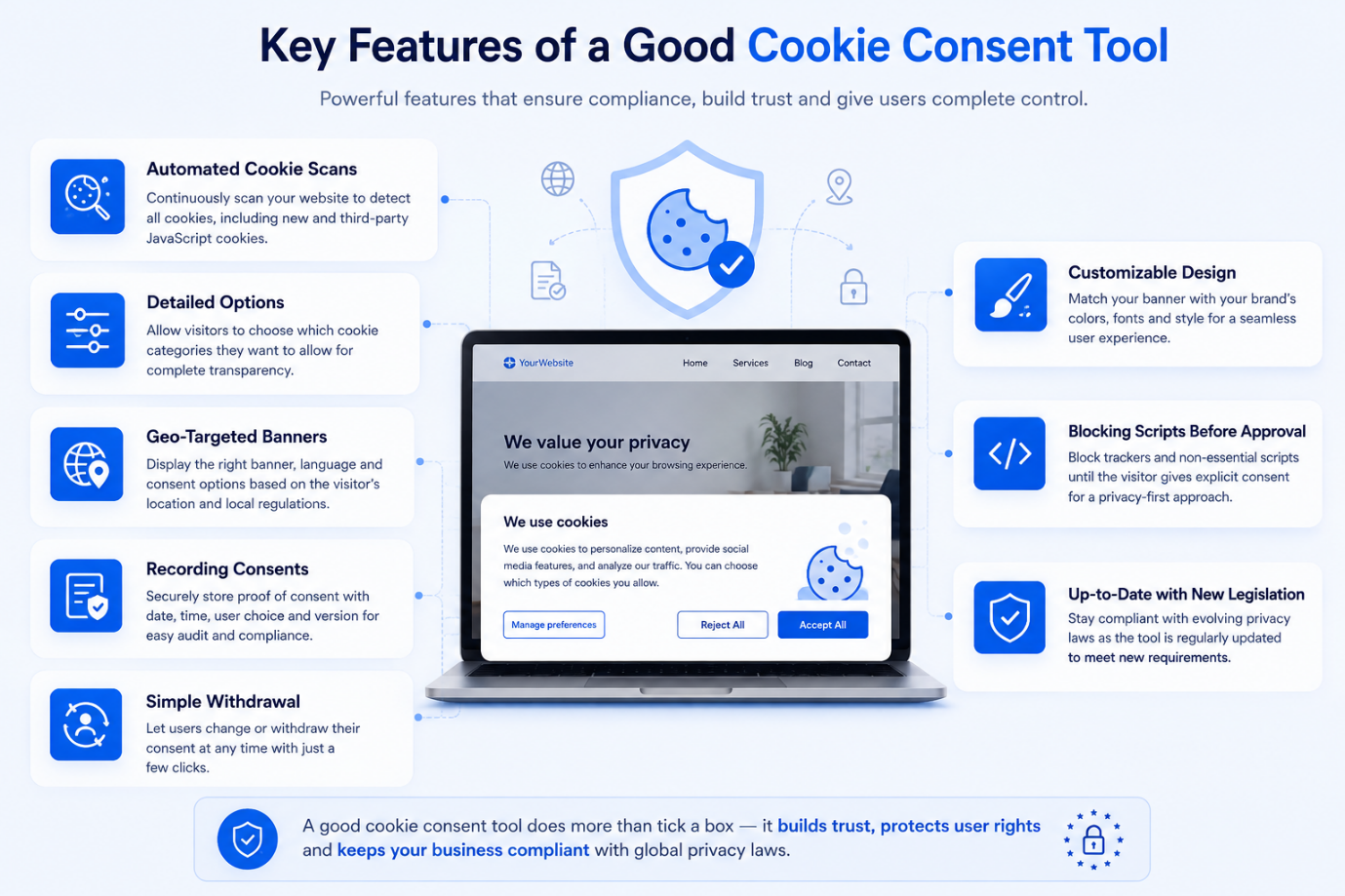
An ideal cookie consent solution must do more than tick a box; it needs to provide a working solution that instills confidence in users while protecting their rights.
Benefits Of Proper Cookie Consent
Applying the correct approach helps in gaining benefits for both your website and your business.
Enhanced legal safety. By following all the protocols, you mitigate the chances of any fines or legal troubles.
Better user experience. A well-designed banner looks professional and does not irritate the users or cover any information they seek.
Improved brand recognition. Companies that comply with relevant guidelines have a good reputation among their target audience.
More accurate statistics. Collecting permission properly allows your analytics to reflect real behavior, which leads to better decision-making in business.
Increased number of website visitors. Users are likely to return to the websites that respect their privacy.
Prepared for stricter future requirements. The privacy policies continue to become stricter every day. Having a solid system in place today means that you will easily adapt to it tomorrow.
How Consentx Helps You Manage Cookie Consent
All of this manual work consumes a lot of time. This process comes with a lot of risks because the laws keep changing. Enter ConsentX. It allows website owners to easily do everything without undergoing all the hassle themselves. ConsentX automatically scans your website checking all your cookies and those added through third-party applications. The identified cookies are sorted into various categories: basic, analytical, marketing, and functional so that everything is clearly organized.
The platform also has customizable banners. You can set the needed design to match your brand and still be compliant with the law. You can control the wording, colors, and general look of the banner. It gives the impression of being an integral part of your site rather than an additional feature. ConsentX provides your visitors with the ability to manage their preferences. Visitors can choose the cookies they want to allow and can change their decision at any time.
ConsentX adheres to various regulations, comprising GDPR and CCPA, as well as precepts from other regional legislations. Hence, the compliance of your site remains intact irrespective of the location of your site visitors. Moreover, the program has the default functionality to block cookies that aren't necessary until consent is provided by visitors. Thus, the system is always compliant, never violating any laws.
ConsentX is a surefire option that allows you to take control of the cookie consent management system without a long setup process.
Conclusion
Cookie consent has become a key part of running a website today. It is not just a legal rule. It is a way to respect your visitors and their data. Once you understand what it means, know the difference between essential and non-essential cookies, follow the right laws, and pick a good tool, you can build a site that is both safe and trustworthy.
Platforms like ConsentX make this easier. They automate cookie scanning. They offer custom banners. They keep accurate records. This lets you focus on growing your business while staying compliant. In the end, handling cookie consent well is not just about avoiding fines. It is about building a safer, more open internet for everyone who visits your site.
Ready to simplify cookie consent for your website? Try ConsentX today and make compliance easier.