
Introduction
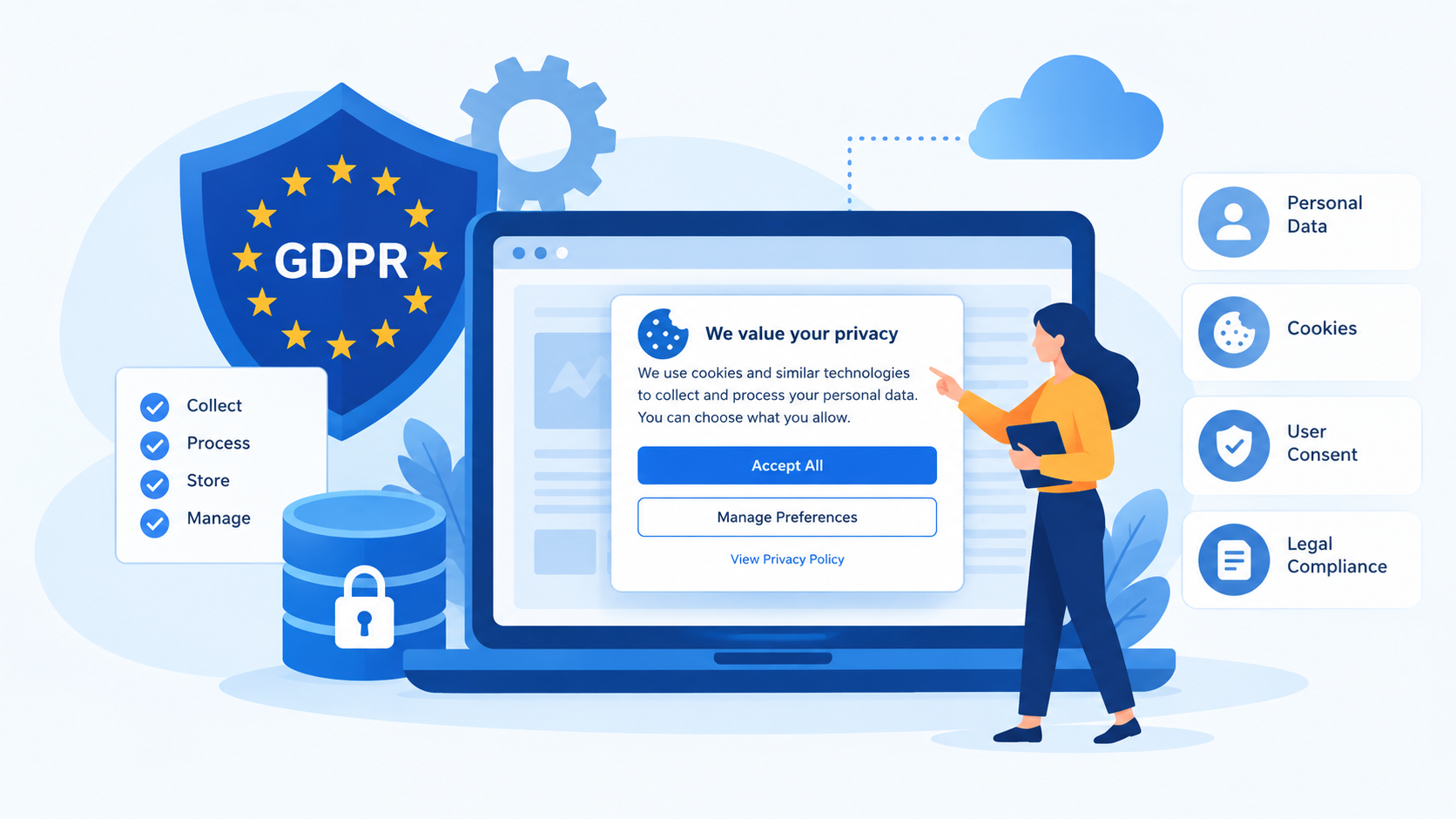
If your website is in any way collecting data from EU visitors, you have most likely heard the term GDPR Consent Management more than once. But what exactly does it pertain to, and why does it matter so much for your business? In short, the GDPR Consent Management definition deals with user consent to collect and process personal data and its management.
Various businesses are prone to believing that installing a cookie banner of any kind is enough for meeting all cookie compliance and legal requirements, but in truth, it is only one minuscule part of the process. In fact, cookie banners are a part of a greater system which takes care of all legal requirements pertaining to cookies, data collection, and user consent. And if you do not have an appropriate toolset for managing user consent, you risk your business facing staggering fines or loss of credibility.
This blog aims to provide a walkthrough of the GDPR Consent Management topic; from the bare minimum needed to stay on the right side of the law to an in-depth analysis of the tools you may want to consider. Small-time bloggers, large-scale SaaS companies, and everyone in between can benefit from reading this article on the topic of user consent management. By the end of this blog post, you will know precisely what is needed to be done to get your website up to snuff in terms of standards of today and what GDPR specifically requires from businesses which operate on the web. We will also provide examples so that our readers can apply what they learn in real life.
Six Essential GDPR Consent Rules
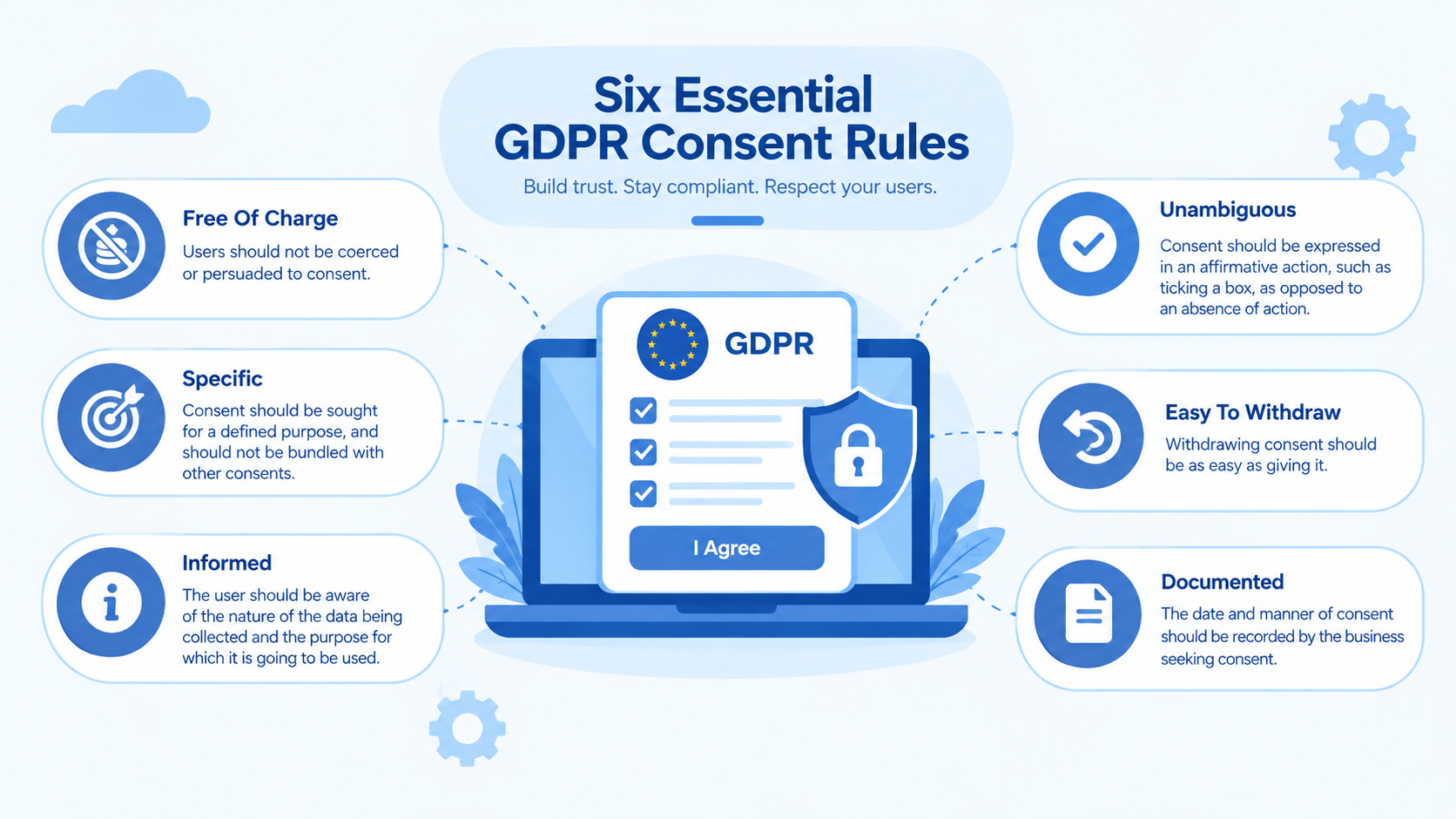
Before you can get control of consent, you'll need to know the basic rules for collecting it that GDPR lays out. Good GDPR Consent Management is only possible when they're all followed, for a mistake even is enough for the collected consent not to be legitimate under the law.
And here are the six rules every company needs to follow:
| Rule | What It Means |
|---|---|
| Free Of Charge | Users should not be coerced or persuaded to consent |
| Specific | Consent should be sought for a defined purpose, and should not be bundled with other consents |
| Informed | The user should be aware of the nature of the data being collected and the purpose for which it is going to be used |
| Unambiguous | Consent should be expressed in an affirmative action, such as ticking a box, as opposed to an absence of action |
| Easy To Withdraw | Withdrawing consent should be as easy as giving it |
| Documented | The date and manner of consent should be recorded by the business seeking consent |
By integrating these six rules into your consent practice, you will be able to ensure full compliance and build a working strategy in which your users feel heard and respected. However, one mistake in one rule can make your entire consent practice invalid according to the law, regardless of how well-developed the rest of your website’s design is.
One way to avoid such pitfalls is to periodically review and update this set of rules, as legislative practice and law interpretation is ever-changing. A few years ago, something that was fully compliant with GDPR requirements would have been sufficient, but today, it is no longer acceptable.
Another way to avoid any unexpected issues is to educate not only the legal department of your company but also other departments, such as marketing and customer service, on the basics of consent rules and their importance.
What Are the 7 Main GDPR Requirements?
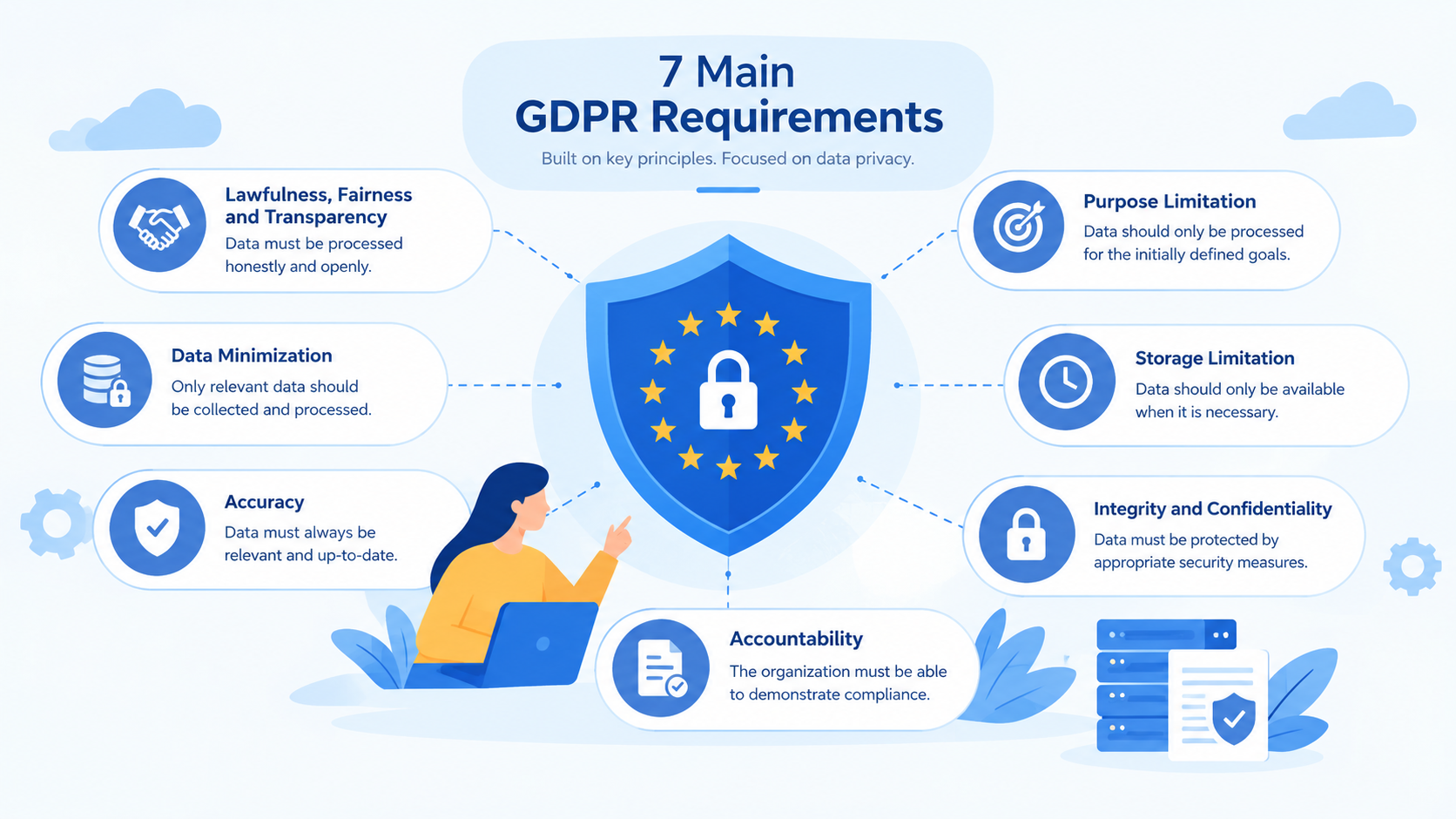
GDPR is based on several key principles that define the rules of personal data processing. These principles help create a comprehensive consent strategy, as they highlight the objectives that cannot be achieved without a properly built system of consents.
The seven key principles are as follows:
- Lawfulness, fairness, and transparency requires honest data processing.
- Purpose limitation data should only be processed for the initially defined goals.
- Data minimization data sets should not include irrelevant data.
- Accuracy data must always be relevant and up-to-date.
- Storage limitation data should only be available when it is necessary.
- Integrity and confidentiality data must be protected by appropriate measures.
- Accountability: the organization that processes data must be able to demonstrate compliance.
A GDPR compliant consent management tool helps an organization fulfill each of the requirements. In most cases, one tool helps achieve multiple goals as it is built around general rules of data processing. For instance, a properly built consent management system helps maintain accountability, transparency, and purpose limitation. At the same time, offering users an option to withdraw consent helps achieve the principle of purpose limitation and data minimization.
When implementing a system that would help fulfill each of the requirements, companies often focus too much on the goals themselves and overlook one critical detail: these principles should be used as a compass. New features, tools, and third-party services that involve personal data in any way should be evaluated in terms of existing principles. A company should ask itself if a particular innovation aligns with the existing GDPR-related goals or not rather than waiting for users to object to their processing practices.
Moreover, an employee that works directly with personal data should know the principles well enough to be able to shape the company’s GDPR strategy. This way, the rules would become an integral part of daily operations and would help build better data processing practices overall. In many ways, principles act as a motivating factor for organizations that are genuinely interested in creating systems with user privacy in mind.
What Are the Legal Reasons for Processing Data Under GDPR?
Consent is not the sole legal basis for personal data processing under GDPR, though it is the most common one for marketing activities and cookies. Knowing the other legal bases can help you apply the right measures to specific situations, instead of relying only on consent checkboxes.
Six legal bases are allowed and recognized by GDPR:
| Legal Basis | Example Use Case |
|---|---|
| Consent | Email marketing, non-essential cookies |
| Contract | Processing payment for contract performance |
| Legal Obligation | Tax Related Processing |
| Vital Interests | Processing of medical information (life-saving cases) |
| Public Task | Processing operations for government functions |
| Legitimate Interests | Fraud or security prevention (limited scope) |
Most internet-based companies and services have to operate mostly on the first legal basis, which is why the GDPR Consent Management becomes vitally important. Marketing-specific cookies, analytics, and personalization tools require explicit consent to be placed on the end-user’s device. Note that sometimes legitimate interest may be used instead of consent, but it requires higher levels of documentation and transparency. Organizations should avoid using this basis when consent is a viable alternative to avoid the risks of user mistrust and regulatory intervention.
When choosing between the possible legal bases for your organization, it is essential not to make a mistake and select the one that would apply universally. Otherwise, if regulators determine that legitimate interests are used inappropriately, the consequences may be severe for businesses, as well as the user base they rely on.
How Can You Get GDPR Consent?
Getting valid consent is the cornerstone of the GDPR Consent Management, which should be user-friendly and transparent to avoid any misunderstanding between the service provider and the client.
Below are the essential steps for collecting user consent on a website:
- Display a Banner with Information about Data Collection - the user must know exactly what data is being collected and for what purpose.
- Give the User an Option to Accept/Reject - the default setting must be “not accepted”.
- Do not Use Ambiguous Language - the user should be able to understand the text without any additional explanations.
- Make Each Purpose Independent - if the user wants to accept cookies for marketing purposes, functions, and analytics, they should be able to do so without accepting all at once.
- Store the Necessary Information - the website must be able to display the date and time of consent, the version of the policy, and the user’s choice.
- Provide an Easy Way to Withdraw Consent - the user should be able to undo their decision in one click.
After implementing these steps, the website will be able to provide a GDPR-friendly Consent Management solution that is easy for users to understand. Besides, it is crucial to keep in mind that the user must give consent every time there is a change on the site, such as a new third-party plug-in.
Furthermore, some companies provide the option to translate the cookie policy banner in the local language of the user, thus enhancing the user experience (UX). Lastly, it may be helpful to test the website from the user’s perspective, go through the process of giving or withdrawing consent, check how the website acts after rejecting cookies, and ensure that all tracking elements are disabled.
How SaaS Companies, Agencies, and Apps Can Manage GDPR Consent?
Different types of businesses have different requirements for consent management. A website and a SaaS are not the same in terms of consent management solutions.
Such solutions for Software as a Service products as GDPR Consent Management need to be embedded into the product. This means that the interface for managing consent has to be in the product itself and not only on the website. Furthermore, for such projects, it is vital to have a consent management solution for all the customers and every account’s data should be separated.
For agencies, the requirement is connected with the work with several websites and the task of managing their consents. The best solution for such agencies would be an aggregated dashboard for all the websites and managing banners. This will help them update the banners and check the consents easier. With other types of businesses, the requirements are connected to the provision of services via mobile apps. The management of consent within apps is the most complicated one as mobile apps usually require additional permission beyond the website, such as providing the app with the user’s location data. The rules for apps’ consent management should be the same as for websites. As mobile apps’ popularity grows, the importance of managing consent via mobile devices increases as well and regulatory authorities are now focused on this matter.
However, despite the difference in requirements, there are some similarities between the needs of agencies, SaaS, and mobile apps. These similarities are centered around the theme of visibility. For these business types, the most critical aspect of consent management is the ability to have a birds-eye view of the consents and their statuses. This view is vital for all three types of organizations as it allows them to respond to any questions or inquiries from users and regulators in a timely and efficient manner.
Finding the Best GDPR Consent Management Solution
With so many tools available, it can be hard to know which one is right for you. Focus on the must-have features: something that will help you be compliant but also easy to work with.
| Feature To Look For | Why It Matters |
|---|---|
| Customizable Banners | Matches Your Brand While Staying Compliant |
| Multi-Language Support | Helps Serve International audiences fairly |
| Consent Logos and Records | Provides proof during audits and disputes |
| Auto-Blocking Scripts | Stop Trackers until consent is given |
| Regular Compliance Updates | keep up with changing GDPR Rules |
| Easy Integrations | Works smoothly with your existing website or app |
The right tool should also grow with you: you may start using it for one website, but if you expand your service to more sites or use more tools, you want to make sure that the tool can scale with you. This can save you engineering and legal headaches as you move forward.
ConsentX understands that you want something simple and effective to manage multiple clients, websites and apps, while providing you the ability to customize the banners for your own use cases.
While demos can be helpful, we recommend that you request a test drive or trial so that you can see firsthand just how easy something like the customizable banner display in ConsentX can be for your website, see how fast it can block scripts and know what your reports and records would look like.
Conclusion
The management of GDPR consent is no longer an optional practice for any company that collects and processes users’ data. Everything from the six basic rules to the seven points is needed to gain the trust of your audience.
Your website, web application, or agency management practice will benefit significantly from a properly set up tool for managing consents. This way, not a single penny will be wasted on possible violations, and you will show your clients that you respect their privacy. And all this is necessary for trust and a good reputation. The right choice of instruments for GDPR compliance will allow you to spend much less time on the direct management of consents.
Try Consentx Today and make GDPR Consent Management effortless.