 ConsentX
DPDPA is being phased in. Scan your site to see where you stand. Scan now
ConsentXGoogle Consent Mode v2 tells Google Analytics and Google Ads what your visitor agreed to, so your tags respect their choice.
Also known as: Consent Mode v2, Google Consent Mode, Google Consent Mode 2, GCM v2
Version 2 added two new signals, ad_user_data and ad_personalization, to the original ad_storage and analytics_storage. Together, these four signals tell Google whether it can store cookies, measure visits, use data for ads and personalise ads.
Consent Mode is not a cookie banner or a Consent Management Platform (CMP). The banner or CMP collects the visitor's choice, and Consent Mode only passes that choice to Google. If you run Google Ads or GA4 for visitors from the EEA or UK, setting it up correctly is important.
Google Consent Mode v2 is a technical mechanism that connects a website's consent choices with Google's advertising and analytics technologies.
Google describes Consent Mode as a way to adjust Google tags' behaviour based on user consent choices. It can be implemented through a CMP or a custom consent banner.
The major change in Consent Mode v2 was the addition of two consent signals:
These were added to the existing:
Google's current documentation identifies these consent settings and explains their respective roles.
| Signal | What it controls |
|---|---|
| ad_storage | Whether advertising-related cookies or storage can be used |
| analytics_storage | Whether analytics-related cookies or storage can be used |
| ad_user_data | Whether user data can be sent to Google for advertising purposes |
| ad_personalization | Whether data can be used for personalised advertising |
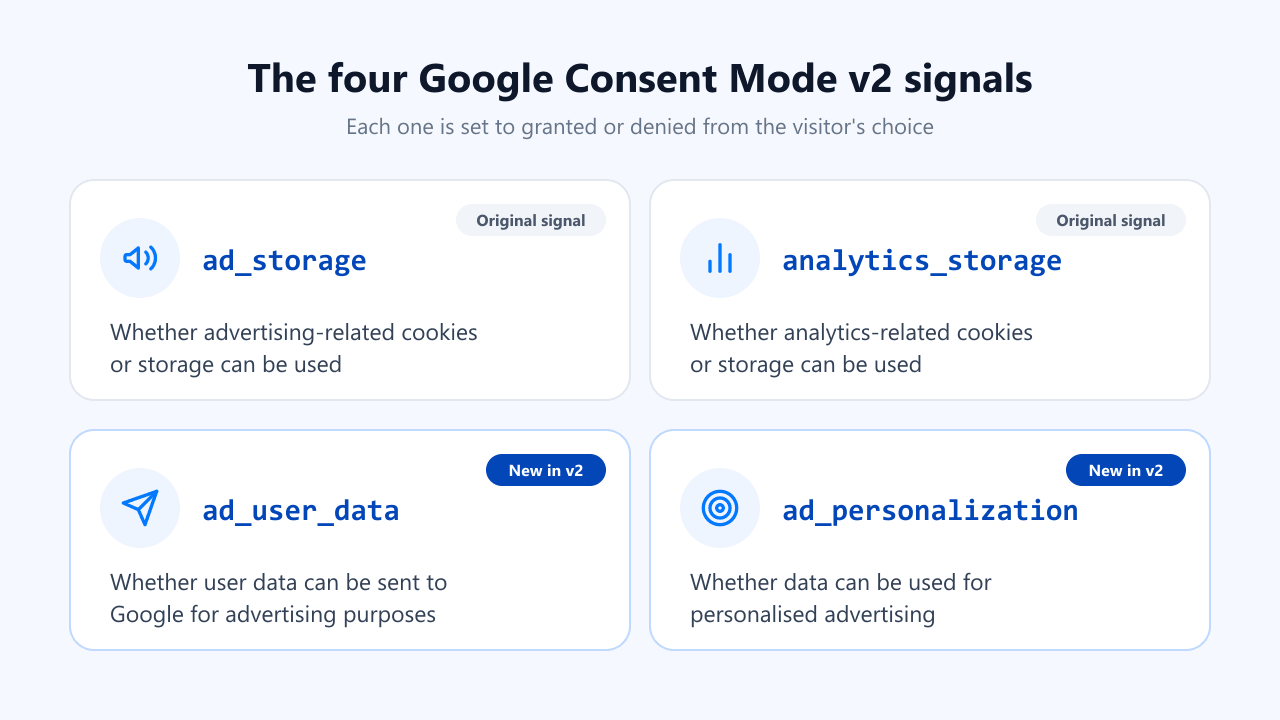
The exact behaviour associated with each signal depends on the Google product and implementation.
ad_storage communicates whether the user has granted consent for advertising-related storage.
When the relevant consent state is denied, Google advertising tags can adjust their behaviour rather than treating advertising storage as permitted.
This signal is primarily concerned with advertising cookies and related storage.
analytics_storage communicates whether the user has granted consent for analytics-related storage.
It is particularly relevant to Google Analytics.
When analytics storage is denied, Google tags can change their behaviour accordingly rather than assuming that analytics cookies or storage are permitted.
ad_user_data is one of the two additional signals introduced with Consent Mode v2.
It communicates whether consent has been granted for sending user data from events and user properties to Google for advertising purposes. Google's documentation defines this signal as either GRANTED or DENIED.
This is different from simply asking whether an advertising cookie can be stored.
A user could therefore have a consent state in which advertising storage and the use of user data are evaluated as separate permissions.
ad_personalization communicates whether the user has consented to personalised advertising.
Google defines the signal as consent for personalised advertising and uses GRANTED or DENIED states.
This signal is particularly relevant to advertising personalisation and audience-based advertising.
Google supports different Consent Mode implementation approaches, including Basic and Advanced consent mode.
The distinction is important because they differ in how Google tags behave before a user interacts with the consent interface.
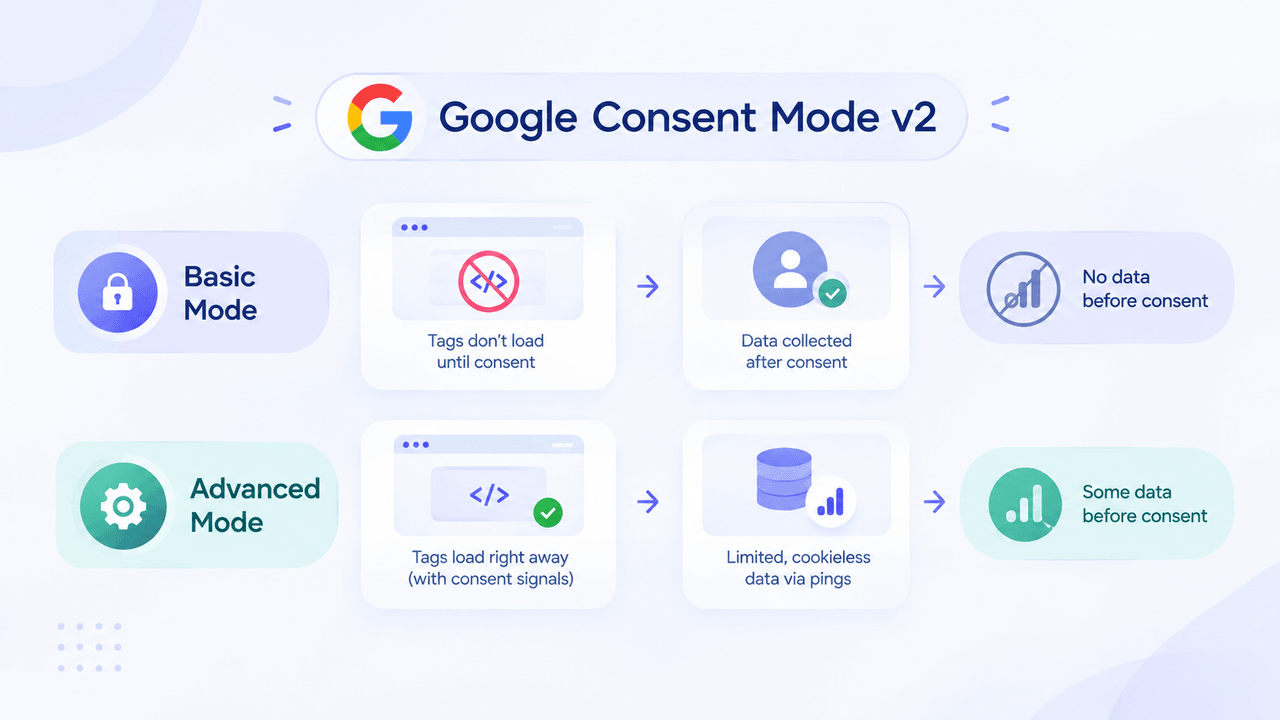
In a basic implementation, Google tags can be prevented from loading until the visitor interacts with the consent mechanism.
This can provide a stricter approach where the website wants Google tags to remain inactive until a consent decision has been made.
In Advanced Consent Mode, Google tags can load with consent defaults and adjust their behaviour based on the consent state.
Google's current documentation describes Advanced Consent Mode as the default approach in some of its mobile implementations and distinguishes it from Basic Consent Mode.
The choice between Basic and Advanced should be evaluated alongside the organisation's legal requirements, Google product configuration and desired measurement approach.
A simplified implementation looks like this:
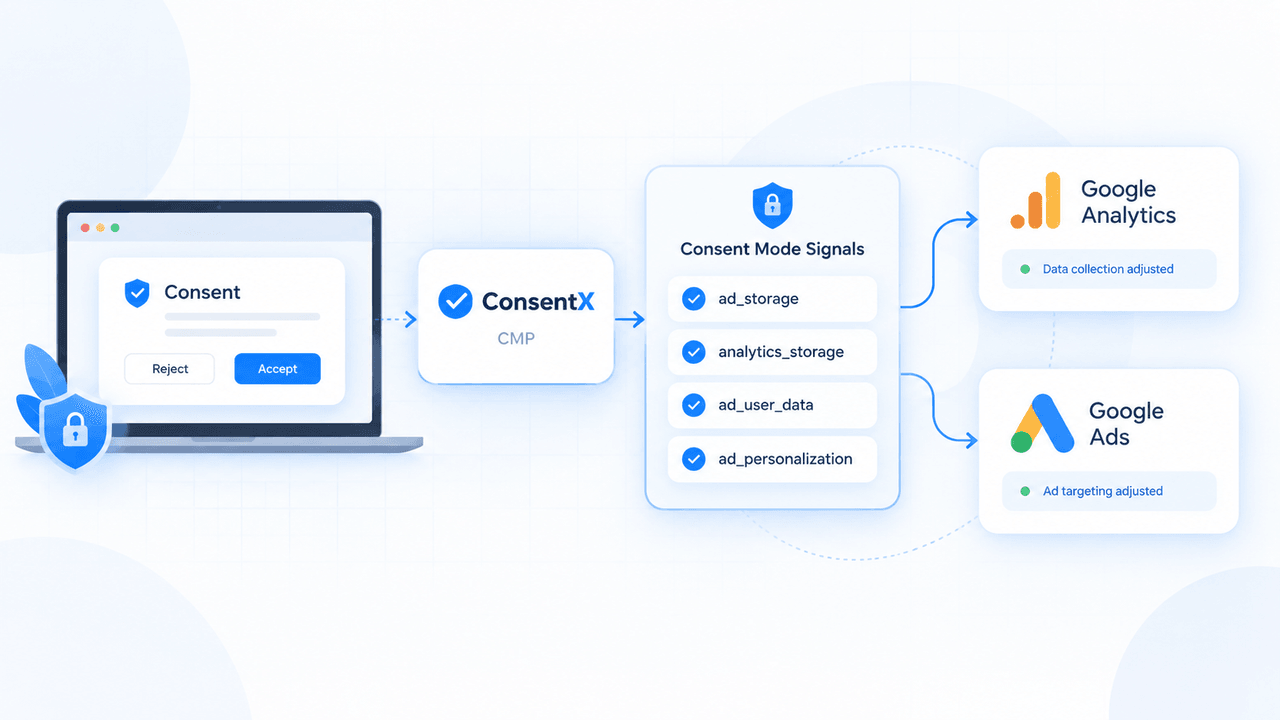
The website establishes the initial consent state before the relevant Google tags operate.
The CMP or consent mechanism presents the applicable choices to the visitor.
The visitor accepts, rejects or customises their privacy preferences.
The website sends the appropriate consent state to Google.
Google tags adjust their behaviour according to the consent signals.
If the visitor later changes their privacy preferences, the website should update the consent state accordingly.
This creates a connection between the user's privacy decision and the technical behaviour of Google services.
Consent Mode is designed so that Google tags can adjust their behaviour when relevant consent is denied.
For example, where analytics_storage is denied, Google Analytics-related storage is not treated as permitted.
Where advertising-related consent is denied, advertising tags can adjust their behaviour accordingly.
Google also provides measurement approaches involving modelling in supported implementations. The exact behaviour depends on the Google product, Consent Mode configuration and implementation.
The important principle is:
Denied consent should be communicated to the relevant Google tags rather than being treated as granted.
Google Consent Mode v2 is the updated version of Google's Consent Mode framework.
The main distinction is the addition of the two advertising-related consent signals:
Original Consent Mode signals:
Consent Mode v2:
The additional signals provide more granular communication of a user's advertising-related privacy choices.
No.
Google Consent Mode v2 and a Consent Management Platform are different technologies.
A CMP is responsible for collecting and managing the user's privacy choice.
Google Consent Mode communicates the resulting consent state to Google tags.
For example:
A CMP may therefore integrate with Consent Mode, but Consent Mode itself does not replace the CMP.
| Google Consent Mode v2 | Consent Management Platform |
|---|---|
| Google technical framework | Privacy-management platform |
| Communicates consent states to Google | Collects and manages user choices |
| Controls Google tag behaviour | Can control Google and non-Google technologies |
| Uses Google consent signals | Can support multiple privacy frameworks |
| Not a complete consent interface | Typically provides the consent interface |
| Does not replace legal compliance | Supports the technical implementation of compliance |
The two technologies are complementary rather than competing.
A cookie banner is the interface through which a website can present privacy choices to a visitor.
Google Consent Mode is the technical mechanism used to communicate applicable consent states to Google tags.
They perform different functions.
| Cookie banner | Google Consent Mode v2 |
|---|---|
| Presents privacy choices | Communicates consent states |
| Interacts directly with the user | Communicates with Google tags |
| Can collect consent | Does not itself constitute a consent interface |
| Can provide granular choices | Translates relevant choices into Google consent signals |
| Part of a broader CMP implementation | Google-specific technical framework |
A website can therefore have a cookie banner without correctly implementing Consent Mode.
Likewise, implementing Consent Mode does not automatically make the website legally compliant.
These are also different technologies.
Google Tag Manager is a tag-management system used to deploy and manage tags.
Google Consent Mode is a consent-state framework that tells Google tags how to behave based on user privacy choices.
They can be used together, but one does not replace the other.
Consent Mode helps make sure a visitor's "no" actually reaches Google. When someone rejects analytics or ads, the matching signals are set to denied, and Google tags change how they behave instead of treating the choice as a yes.
This protects visitor privacy in three ways:
Consent Mode only talks to Google tags. It does not stop other trackers such as Meta Pixel, LinkedIn Insight Tag or Hotjar. To keep those quiet until the visitor says yes, you also need a CMP with prior-script blocking.
Not by itself.
This distinction is extremely important.
Consent Mode communicates consent state. It is not the same thing as a script-blocking mechanism.
A CMP or tag-management implementation may determine whether a tag is allowed to execute, while Consent Mode communicates the consent state to Google tags.
For websites requiring prior consent, organisations should therefore consider both:
ConsentX's prior-script blocking capability addresses the first part, while its Google Consent Mode integration addresses the second.
For jurisdictions where prior consent is required for certain technologies, implementing Consent Mode does not eliminate the need for appropriate consent controls.
For example, a website may configure Google Analytics to receive a denied analytics_storage state, but it still needs to assess whether the underlying implementation complies with applicable cookie and privacy rules.
This is why Consent Mode should be treated as one component of a broader consent architecture, rather than as a substitute for consent management.
Consent Mode primarily communicates consent to Google technologies.
It does not automatically control every third-party tracker on a website.
A website may also contain:
These technologies require their own consent controls where applicable.
This is why a website-wide CMP and prior-script blocking system can be more comprehensive than relying on Google Consent Mode alone.
Google Consent Mode v2 does not make a website legally compliant on its own, but it helps you pass a visitor's privacy choice to Google tags. This is how it fits with the main privacy laws:
Where consent is needed, you must collect it before using cookies or personal data for ads and analytics. Google's EU User Consent Policy also expects this for EEA and UK traffic. Consent Mode is the way you pass that choice on to Google.
obtains and manages consent
communicates the resulting state to Google
adapt behaviour to that state
Google itself recommends consulting legal teams to ensure that consent mechanisms meet applicable regulatory requirements.
Google's EU User Consent Policy imposes specific requirements on publishers and advertisers operating in relevant European markets.
Google states that publishers must obtain consent for the use of cookies or other local storage where legally required and for the collection, sharing and use of personal data for personalised advertising. For relevant advertising products, Google also requires appropriate consent-management mechanisms.
Therefore, Consent Mode v2 is particularly important for organisations using Google advertising and measurement products with relevant European traffic.
No.
Consent Mode is a technical integration, not a complete compliance solution.
It does not by itself:
A complete compliance architecture may require a CMP, prior blocking, privacy notices, consent records, rights management and other controls.
Consent must be clear, and visitors must be able to withdraw it. Consent Mode helps carry a withdrawal into Google tags, so they stop treating the earlier choice as valid.
This law is mainly about opt-out rather than opt-in. Consent Mode can still help reflect a visitor's choice in Google tags, and you can pair it with Global Privacy Control and region-based rules for US visitors.
No single tool covers all of this. You also need a valid consent banner, a clear privacy notice, control over non-Google trackers and consent records as proof of each choice.
Google Consent Mode is closely associated with Google Analytics 4 (GA4).
The consent state can affect how Google Analytics processes information.
For example, analytics_storage communicates whether analytics-related storage is permitted.
Google's current documentation also exposes consent settings such as ad_user_data and ad_personalization in its measurement infrastructure.
A correct GA4 implementation should therefore ensure that the consent state communicated by the website accurately reflects the user's privacy choice.
Consent Mode is also important for websites using Google Ads and related advertising technologies.
Advertising-related consent can affect:
The specific impact depends on the Google product and configuration.
A CMP can translate a visitor's advertising preferences into the corresponding Consent Mode signals.
Google Tag Manager (GTM) can be used to deploy Google and third-party tags.
Consent Mode can work alongside GTM to communicate consent states and control tag behaviour.
However, simply installing Consent Mode through GTM does not guarantee that every tag respects the user's privacy choice.
A robust implementation should evaluate:
This is particularly important when GTM contains non-Google advertising or analytics tags.
A proper Consent Mode audit should test the website in several states.
Check:
Check:
Check:
Check:
Check:
Consent Mode does not replace the user-facing consent interface.
Consent Mode does not automatically prevent every tracker from firing.
Consent Mode v2 includes additional signals for user data and advertising personalisation.
Analytics consent needs to be represented separately where applicable.
A website can contain many third-party technologies outside Google's ecosystem.
A consent system needs to handle both the initial decision and subsequent changes.
Consent Mode is a technical framework. Legal compliance depends on the broader implementation.
A practical implementation checklist includes:
ConsentX acts as the consent-management layer that captures the user's privacy choice and communicates the relevant state to Google technologies.
A simplified architecture is:
At the same time, ConsentX can provide additional controls around the broader website environment, including:
This is important because Google Consent Mode handles the Google-specific consent layer, while a CMP can manage the broader privacy decision.
Google Consent Mode v2 works best when it is connected to a broader consent architecture.
The goal is not simply to install a Google script. It is to ensure that:
ConsentX helps organisations collect privacy choices, enforce tracker behaviour and communicate consent states to Google technologies through Consent Mode v2. Connect your consent management system to Google Consent Mode v2 with ConsentX.
Google Consent Mode v2 is Google's framework for communicating user consent choices to Google tags.
The most important points are:
Software that collects, manages, enforces and records user privacy choices.
A mechanism for obtaining and managing consent for cookies and similar technologies where consent is required.
Preventing relevant non-essential trackers from executing before the required consent is obtained.
Google's analytics platform, which can use Consent Mode signals to adjust its behaviour.
Google's tag-management platform for deploying and managing website tags.
Consent Mode signal controlling advertising-related storage.
Consent Mode signal controlling analytics-related storage.
Consent Mode v2 signal relating to sending user data to Google for advertising purposes.
Consent Mode v2 signal relating to personalised advertising.
The European Union's comprehensive data-protection regulation.
An advertising-industry framework for communicating consent and vendor choices in the programmatic advertising ecosystem.